When Slow Waves Reach Sensitized Smooth Muscle Cells, Action Potentials and Contraction Result
Slow waves have an important relationship with muscle contractions, but they are not the direct stimuli for contractions. Slow waves are constantly passing over Gl smooth muscle, whether it is actively contracting or not.
GI smooth muscle cells, as with other muscle cells, contract in association with action, or spike, potentials. These potentials are characterized by complete depolarization of the membrane for a short time, in contrast to the slow waves, which are characterized by incomplete depolarization (see Chapter 4). Action potentials in the GI smooth muscle occur only in association with slow waves. Thus the presence of slow waves is necessary but not sufficient to cause muscle contractions. When slow waves pass over an area of smooth muscle without eliciting action potentials, no contractions occur. When slow waves pass over an area of smooth muscle and action potentials are superimposed on the slow waves, gut muscle contracts. Control and coordination of smooth muscle activity is achieved by influencing the likelihood that action potentials will be superimposed on slow waves. Such control is a function of the neurohumoral substances produced by the ENS and enteric endocrine/paracrine system.Smooth muscle control and coordination are achieved by modulation of the baseline electrical potential in the smooth muscle cells. Neurohumoral regulatory molecules from ENS neurons or endocrine/paracrine cells are released in the vicinity of the smooth muscle cells, affecting membrane ion channels and influencing the baseline membrane potential (see Chapter 27). Excitatory molecules elevate the baseline (bring it closer to zero), and inhibitory molecules lower the baseline (make it more negative). The position of the baseline influences how close the overall potential will come to O mV at the crest of a slow wave. When the membrane potential of a smooth muscle becomes close to zero» action potentials occur and muscle contracts (Figure 28-3).
Neurohumoral substances (neurocrines, paracrines, and hormones) that are excitatory elicit smooth muscle contraction by elevating the baseline, whereas inhibitory substances inhibit muscle contraction by lowering the baseline.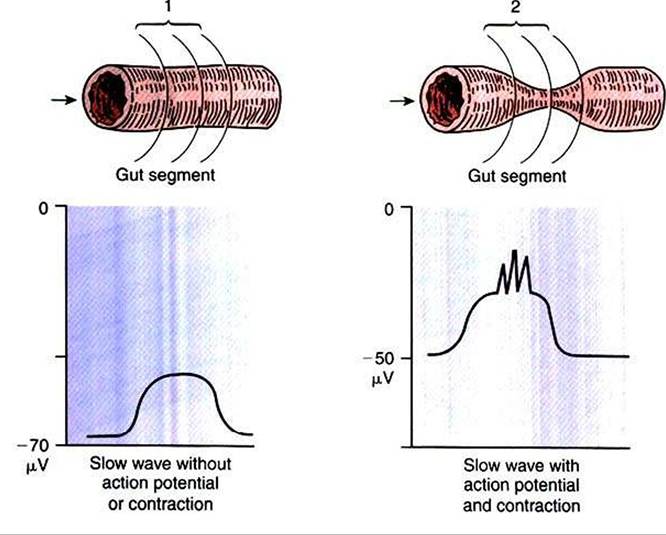
FIGURE 28-3 7, No muscle contraction
occurs in the absence of action potentials. 2, Muscle contracts when the crest of the slow waves reaches a critical point of depolarization, allowing action potentials to occur. The probability of action potentials occurring during the passage of a slow wave over a segment of gut muscle is influenced by the degree of baseline depolarization. Norepinephrine lowers the baseline (increases its absolute value), whereas acetylcholine raises the baseline (decreases its absolute value). μV, Microvolts.
The integrated actions of the slow waves, ENS, and endocrine/paracrine system appear to function to synchronize the contractions of the GI muscle mass. In order for the muscle to perform efficiently, all or many of the muscle cells in one layer of a segment of gut must be synchronized to contract simultaneously. This can best be visualized by considering the circular muscle layer. 'Γhe contents of the circle cannot be “squeezed” effectively unless all the muscles of the circumference contract simultaneously; it would have little effect on luminal pressure if one portion of the circle contracted while another portion relaxed. In any discrete area of gut, slow waves pass simultaneously over the entire circumference of the smooth muscle. If that area has been sensitized by an excitatory neurohumoral regulatory molecule, the entire circumference of circular muscle will contract in synchrony.
Muscle contractions can occur al a frequency no higher than the frequency of the slow waves. As an example of frequency modulation, consider the activity of muscle in the stomach of the dog. Slow waves in the canine stomach occur about five times per minute. The crest of each slow wave may or may not be accompanied by action potentials. Therefore, during a given minute, the muscle in a localized area may not contract at all or may contract up to five times. If the passing slow waves generate no action potentials, the muscle does not contract at all. In a given minute, if action potentials are associated with one slow wave, the muscle contracts once. Action potentials on two slow waves result in two contractions, and so on, up to a maximum of five contractions per minute, but no more than five, because there are no more slow waves.
The motility patterns of the gut vary in their complexity, as described in the following sections. In the stomach and colon, motility patterns are relatively complex compared with the small intestine. In all cases, motility patterns are programmed into the ENS and coordinated in conjunction with the slow waves.