During the act of swallowing, the regurgitation of food into the nasopharynx and its aspiration into the larynx are both prevented by the coordinated activity of the pharyngeal muscles.
These muscles arch over the roof of the pharynx to meet their contralateral fellows at a median raphe, and their contractions occur in sequence but overlap, ensuring that in cooperation they effect the movement of food toward and into the esophagus.
The more rostral constrictor muscles also draw the pharynx forward and upward for the better reception of the food bolus as it is passed from the mouth. An essential feature of the process is the sphincter-like closure of the intrapharyngeal ostium that involves elevation of the soft palate, in part effected by the small muscles (tensor and levator) that pull the palate taut between the pterygoid bones. The timely relaxation of the cricopharyngeus muscle allows food to escape into the esophagus. During the process, the larynx is raised while its entrance is partially blocked and the glottis closed.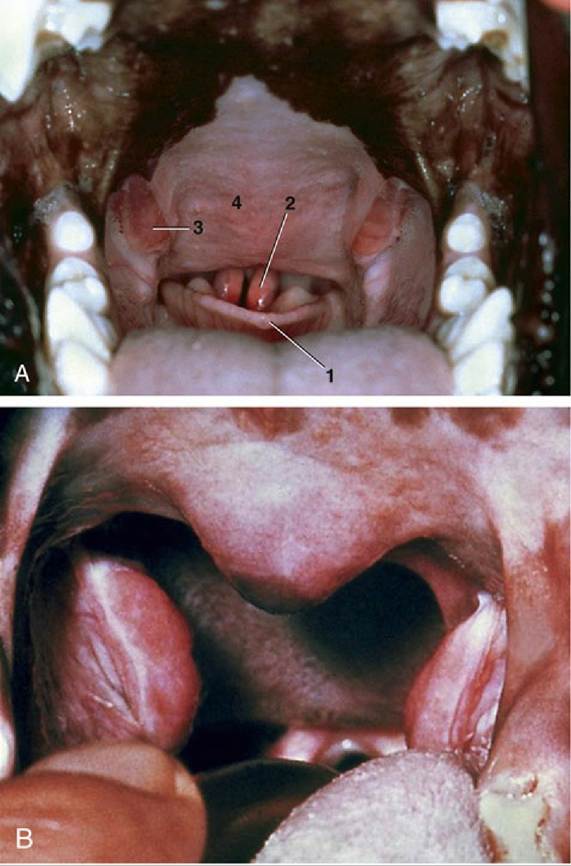
FIG. 11.31 (A) Oropharynx. 1, Epiglottis; 2, cuneiform processes of arytenoid cartilages; 3, palatine tonsils; 4, soft palate. (B) Palatine tonsils; the caudal part of the soft palate is missing.
Inappropriate closure of the intrapharyngeal ostium provokes sneezing.
More on the topic During the act of swallowing, the regurgitation of food into the nasopharynx and its aspiration into the larynx are both prevented by the coordinated activity of the pharyngeal muscles.:
-
Veterinarian -