» External Features and Integument
Alpacas come in two varieties with different fleece types. Huacaya alpacas have a short fiber (giving them a teddy bear appearance), which is in contrast to the long crimped dreadlock-like fibers of the Suri variety.
The skin thickness of the camelid varies, with the skin of the neck being very thick in both intact and late-castrated male alpacas and llamas. This increases the difficulty of venipuncture in the neck. The thickest skin is found on the lateral and dorsal sides of the neck and the dorsal thorax. Camelids develop a large callus over the sternum, and also develop calluses over the carpus and stifle, as a result of sternal recumbency being the preferred resting position. The skin is the thinnest in the concave surface of the pinnae, perineal region, axillae, and caudal ventral abdomen. Fiber density also varies on the body, with relatively sparse fiber in the perineal, sternal, ventral, axillary, and inguinal areas, making these areas convenient to observe the skin. The coat can also be parted to observe the character of the skin. Some llamas may shed from the neck and shoulder region twice yearly.
FIG. 38.3
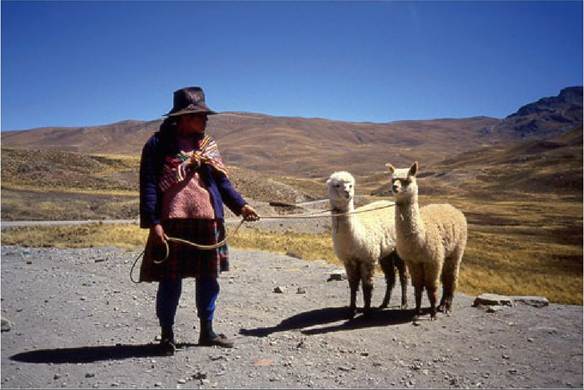
Andean woman with alpacas in Huascaran National Park (Peru). (Image by Jaxxon; unmodified from
original. Available at: https://commons.wikimedia.org/wiki/File:Andean_woman_with_alpaca.jpg. This work is licensed under the Creative
Commons Attribution-Share Alike 3.0 Unported, 2.5 Generic, 2.0 Generic and 1.0 Generic license.)
Camelid Skin: The relatively hairless axilla and inguinal regions are important for dissipation of heat because these areas contain the highest concentrations of sweat glands and also high concentrations of blood vessels. Camelids often rest in sternal recumbency with the hocks elevated behind them for air circulation over these areas for cooling.
The preferred place for intradermal tuberculin skin testing is in the axillary region.Llamas have the normal sebaceous glands and sweat glands seen in other species, but the sebaceous glands are less active than those of sheep, and the fleece is not as oily. Llamas also lack modified sebaceous glands found in other species, in specialized areas such as the perianal region, prepuce, glans penis, vulva, anus, and eyelid. The sebaceous glands that are present have nonkeratinized ducts, in contrast to most species. South American camelids appear to have a concentration of sweat glands similar to those of other species, whereas camels are reported to have fewer sweat glands to help prevent water loss. A study of the microanatomy of healthy alpaca skin found it to be very similar to that of the llama.
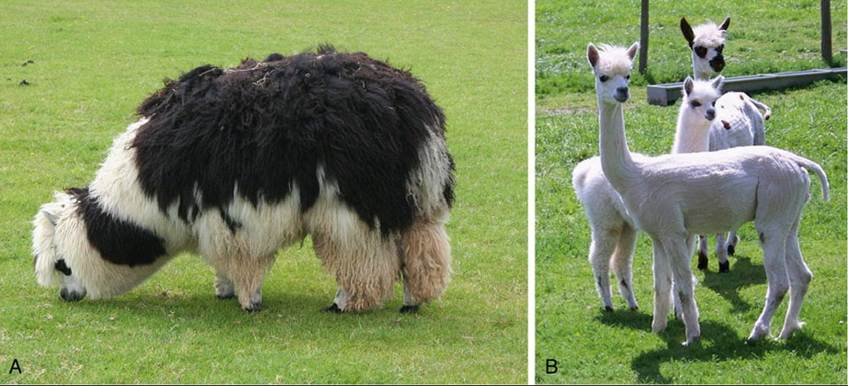
FIG. 38.4 (A) Unshorn alpaca. (B) Shorn alpaca. (A, Image by Johann Dreo, Wikimedia Commons. Unmodified from original. Available at: https://en.wikipedia.org/wiki/File:Unshorn_alpaca_grazing.jpg. This work is licensed under the Creative Commons Attribution-Share Alike 2.0 Generic license. B, Alpaca at Little Durnford Manor, by Trish Steel; modified from original [cropped]. Available at: https://commons.wikimedia.org/wiki/File:Alpaca_-_geograph.org.uk_-_511843.jpg. This work is licensed under the Creative Commons Attribution-Share Alike 2.0 Generic license.)
Oblong skin thickenings are located on the dorsolateral and dorsomedial aspect of each metatarsal region, referred to as metatarsal glands (arrows in Figs. 38.6B and D). Some authors believe them to be associated with pheromone release as an alarm mechanism, but their histologic structure is very similar to that of the eccrine sweat glands found in the llama and carnivore foot pad, and the overlying epidermis is very similar to that of the equine chestnut. Both of these ultrastructural aspects would argue for the metatarsal glands being vestigial digits. They are most easily seen on animals with light-colored legs and actually contain very little glandular tissue. There are also interdigital glands in the dorsal interdigital space. Histologically, the glands seen in the metatarsal glands, the interdigital glands, and the glands of the footpad all resemble eccrine sweat glands.
Whereas other domestic animals usually have either simple or compound hair follicles, llamas have both simple and compound hair follicles. Another peculiarity of the llama skin is the presence of vascular plexuses similar to ones described in guanacos and alpacas and thought to be involved in thermoregulation or water conservation.