» Skull
The skulls of the llama and the alpaca are compared in Fig. 38.7. The skull of camelids is similar to that of a small ruminant, with a few distinct features. The nasal bone of camelids is shortened compared to other species, and it is shorter in the alpaca than in the llama.
The relatively short nasal bone has implications for handling and restraint, as discussed later. The bony orbit is complete, with a prominent palpable notch on the dorsomedial orbit margin in the llama. Llamas and alpacas have an opening rostral to the orbit that is similar to an opening found in cervids, and variously referred to as the rostral foramen, rostral fenestra, prelacrimal vacuity, lacrimal vacuity, lacrimal fenestra, antorbital vacuity, or ethmoidal vacuity (Fig. 38.7). This foramen is reported to be absent in the vicuna, and it is absent in the camel as well. The function of this foramen is unknown. Although one source speculated that this is associated with a scent gland, species with scent glands in this location, such as the deer and sheep, have a lacrimal fossa rostroventral to the orbit to house the scent gland, which the camelids do not have.There is no facial tuberosity, and the facial crest is inconspicuous. The tympanic bulla is flattened in the rostrocaudal plane and extends ventrally to the level of the occipital condyles. Other features are typical of other herbivores and are unremarkable.
The mandible has a reduced angular process, a very rounded angle, and a tall and narrow coronoid process but is otherwise typical of herbivores. The rami of the mandibles are narrowly spaced. The mental foramen is slightly caudal to the mandibular canine tooth.
The frontal and maxillary paranasal sinuses of a llama are outlined in Fig. 38.8. The maxillary sinus is associated with the roots of the upper cheek teeth, as is common in most species.
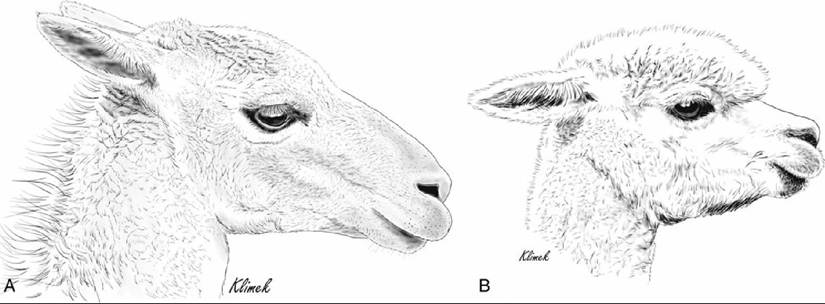
FIG. 38.5 Face structure of (A) llama and (B) alpaca. Llamas have a longer and less hairy face than do alpacas.
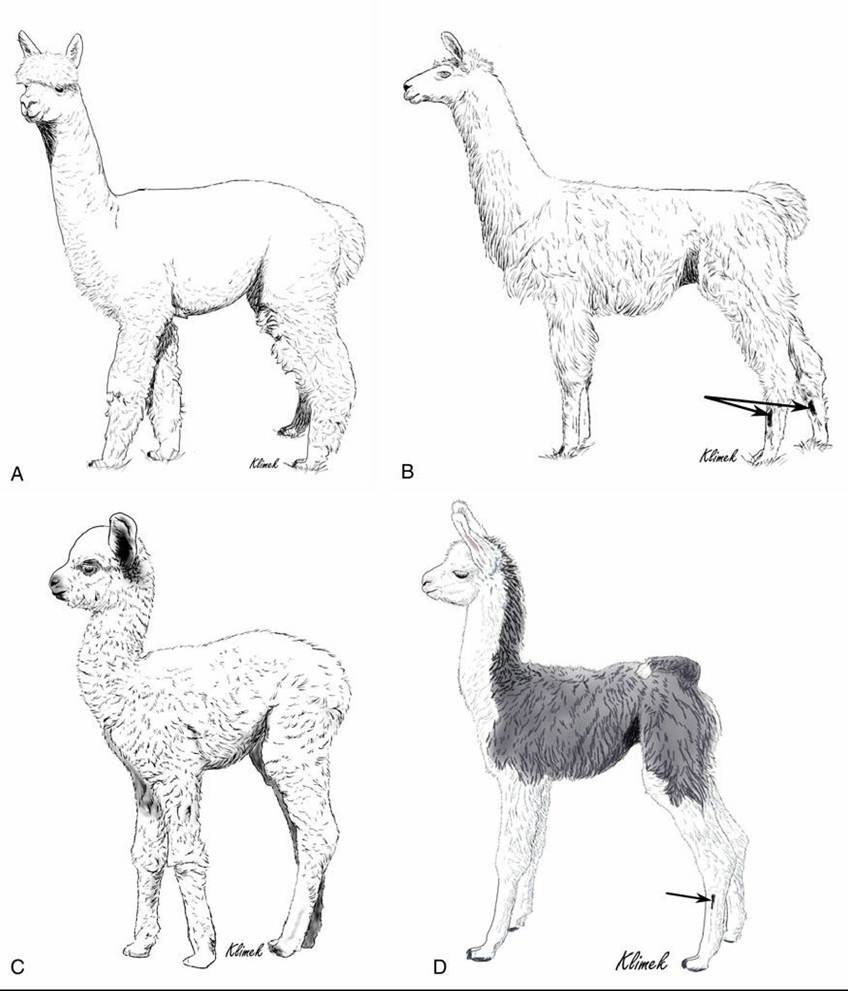
FIG. 38.6 Adult and juvenile South American camelids. (A) Adult alpaca. (B) Adult llama. (C) Alpaca cria.
(D) Llama cria. Arrows in B and D indicate the position of the metatarsal glands. In addition to the larger size of llamas, they have a straighter topline than do alpacas. Alpacas tend to stand with pelvic limbs more tucked under the pelvis.