» General Anatomy of the Pelvis and Perineum (see also pp. 49-50)
The bony pelvis is formed by the pelvic girdle, sacrum, and first few caudal vertebrae; of course the caudal limit of the roof is, as always, difficult to define precisely. Because the bones and their surface landmarks are described in Chapters 2 and Chapter 17, respectively, only a few general features of the anatomy of the pelvis are recapitulated here.
The pelvic cavity is smaller than might be supposed from examination of the intact animal or the isolated girdle. The discrepancy is due to the shallowness of the caudal part of the abdomen and to the acute angle (about 20 degrees) formed between the ilia and the vertebral column (Fig. 15.1). The pronounced obliquity of the inlet places the pubic brim level with, or even behind, the caudal limit of the sacrum. The iliac shafts are not quite parallel, and the inlet is widest in its middle part and narrowest dorsally. The pelvic outlet is less confined than the inlet and possesses a considerable capacity for further enlargement through elevation of the tail behind the very short sacrum. Only a small part of the lateral wall is bony, as neither the ischial spine nor the ischial tuber rises to any great height. In the dog the sacrotuberous ligament is reduced to a narrow cord (under cover of the superficial gluteal muscle) extending between the ischial tuber and the caudolateral corner of the sacrum (Fig. 15.1A).
The pelvic girdle of the cat shows some differences. Cranially, the ilia diverge slightly, producing a somewhat funnel-shaped entrance to the pelvis from the abdominal cavity. The wings of these bones are relatively smaller and shallower, easing the transition. The ischial tubers stand closer together than in the dog, a feature that gives the pelvis a more rectangular appearance in the ventrodorsal view and a more confined exit (Fig. 15.2). In consequence of the last feature the perineum is narrow.
There are no sacrotuberous ligaments in this species.The almost straight axis of the short pelvic canal appears to be well adapted for easy parturition. Sexual dimorphism is not pronounced, and pelvic measurements have not been given much attention in small animal obstetrics. An ill match of the proportions of the fetus and the dam is most common in cases in which the litter is small (and the individual fetus relatively large) in toy dogs as well as in those breeds in which a measure of achondroplasia is a feature of the conformation. On rectal examination the pelvic canal of young dogs is shaped like an hourglass, which may mistakenly suggest a pelvic fracture.
The perineum slopes somewhat ventrocaudally and is largely concealed when the tail is carried low. When the tail is raised, it exhibits a shield of naked integument about the anal orifice and, at some distance ventral to this, the vulva or root of the penis. The ischiorectal fossa between the anus and the ischial tuber naturally varies in prominence with the character of the coat and the degree of obesity. The fossa is bounded by the sacrotuberous ligament and the deep face of the superficial gluteal muscle laterally and by the superficial face of the coccygeus medially. It is traversed by the large caudal gluteal vessels that run against the lateral wall and by the main trunks and certain branches of the internal pudendal vessels and pudendal nerve placed more medially, toward the floor (Fig. 15.3/2 and 3).
The pelvic diaphragm has the usual composition. The lateral muscle, the coccygeus, has a tendinous origin from the ischial spine and inserts on the lateral aspect of the tail between the second and fifth vertebrae (Figs. 3.48 and 15.3). The deeper and thinner levator ani (Fig. 3.48/2) has a wider origin, which extends from the iliac shaft onto the pelvic floor along which it runs, directly to the side of the symphysis (Fig. 15.4/7). The part arising from the pelvic floor closely embraces the pelvic viscera in its passage to its insertion on the tail, reaching as far caudally as the seventh vertebra.
The fibers of the levator ani run more obliquely than those of the coccygeus, and part of the levator ani emerges superficially behind the other muscle. The levator ani has only a passing fascial connection with the external sphincter of the anus, and like the coccygeus, it is primarily a depressor of the tail. However, its fascial attachment enables it to help fix the position of the anus during defecation.The perineal hernia is the escape of the pelvic viscera, due to weakness or atrophy of the muscles of the pelvic diaphragm, into the perineal area. This displaced pelvic organ causes a swelling to the side of the anus. Surgical repair of this condition involves suture of the external sphincter to the coccygeus and internal obturator muscles, and the sacrotuberous ligament about the margins of the space.
The pelvic blood vessels and nerves are sufficiently described in the general accounts (pp. 236 and 313). Because there are only three sacral spinal nerves, the origins of the pudendal, caudal rectal, and pelvic nerves are rather compressed; variations in the branching patterns of the first two are common. The pudendal and caudal rectal nerves supply afferent and efferent fibers to the perineum, and their integrity is necessary for the execution of the perineal reflex that provides a means of gauging the depth of narcosis. The modified skin about the anus is especially sensitive, and even a gentle touch evokes a brisk contraction of the anal sphincter of the conscious or lightly anesthetized animal.
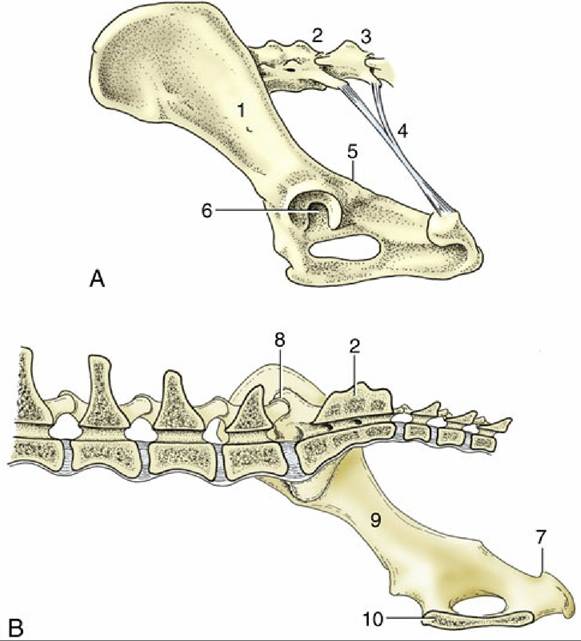
FIG. 15.1 (A) Canine sacrotuberous ligament, left lateral view. (B) Right half of canine bony pelvis, medial view. 1, Ilium; 2, sacrum; 3, caudal vertebra(e); 4, sacrotuberous ligament; 5, ischial spine; 6, acetabulum; 7, ischial tuber; 8, sacroiliac joint; 9, shaft of ilium; 10, symphysis.