Glomerular Filtration Rate Is Determined by the Mean Net Filtration Pressure, Permeability of the Filtration Barrier, and Area Available For Filtration
The glomerular capillary wall creates a harrier to the forces favoring and opposing filtration of the blood. The forces favoring filtration—that is, movement of water and solutes across the glomerular capillary wall—are the hydrostatic pressure of the blood within the capillary and the oncotic
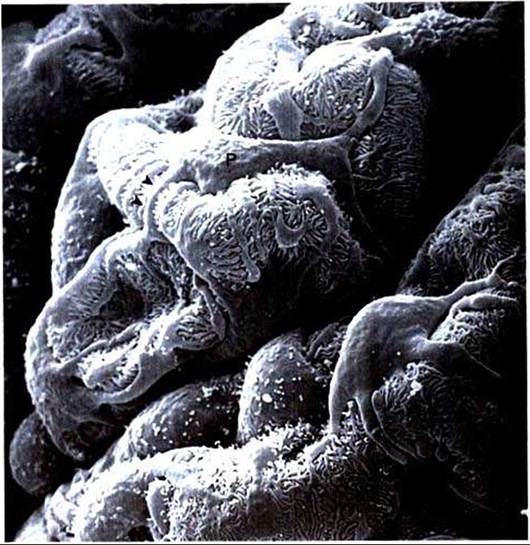
FIGURE 41-5 Scanning electron micrograph of the surface of rat glomerular capillaries viewed from Bowman's space.
The cell bodies (P) of visceral epithelial cells, or podocytes, nestle between the capillary loops.The primary foot processes (arrowheads) radiate outward and wrap around the capillaries. Secondary foot processes extend from the primary foot processes and interdigitate with secondary foot processes from other podocytes. (Magnification "1500.)pressure of the Iluid within Bowmans space (the ultrafiltrate). Normally, the oncotic pressure of the ultrafiltrate is inconsequential because medium- to high-molecular-weight proteins arc not filtered. Therefore the main driving force for filtration is the glomerular capillary hydrostatic pressure. Forces opposing filtration are the plasma oncotic pressure within the glomerular capillary and the hydrostatic pressure in Bowman’s space. Figure 41-6 illustrates the direction and magnitude of these forces under normal conditions.
The net filtration pressure (Pf) at any point along the glomerular capillary is the difference between the capillary hydrostatic pressure (Pgc) favoring filtration and the capillary oncotic pressure (πl,) plus hydrostatic pressure of the ultrafiltrate (Pt) opposing filtration. 'Fhis relationship is expressed mathematically as follows:
Pf = Pwall that is created by negatively charged residues of glycoproteins incorporated in the glomerular basement membrane and coating the endothelial and epithelial cells. These fixed negative charges repel negatively charged plasma proteins and thus reduce their passage across the filtration barrier. The shape and deformability of the molecule also affect its ability to cross the filtration barrier. Neutral dextran, a long, flexible molecule, crosses the filtration barrier approximately seven times as easily as horseradish peroxidase, a globular protein with a similar molecular radius and net charge.