Many Chemical SignaIsAct Locally (as Paracrines) to Exert Important Control on Vascular Resistance
As already described, metabolic control of blood flow is mediated by chemical changes that occur when tissue metabolism increases. In addition to metabolic controls on blood flow, there are many other chemicals that act locally, within a tissue, to affect vascular resistance and therefore blood flow.
Some of these local (paracrine) chemical signals are listed in Table 24-1.Endothelin-I (ET-I) is released from endothelial ceils in response to a variety of mechanical or chemical stimuli, especially those that traumatize the endothelium. Endothelin-I causes vascular smooth muscle to contract, which results in vasoconstriction and a decrease in blood flow. Nitric oxide (NO), another signaling molecule released from endothelial cells, has the opposite effect. NO relaxes vascular smooth muscle, which results in vasodilation. One stimulus for NO release is an increase in blood flow velocity past the endothelium. The NO acts locally to dilate vessels, especially small arteries, which allows them to accommodate an increased blood flow without such high flow velocities. In some tissues, most notably the erectile tissues of the external genital organs (penis and clitoris), parasympathetic nerve endings release both NO and acetylcholine. The acetylcholine stimulates endothelial cells to release additional NO. The NO dilates local blood vessels, which causes engorgement of the tissues with blood, and therefore erection.
Throtnboxane A2 (TXA2) and prostacyclin (PGI2) act antagonistically in the control of vascular smooth muscle and also in the control of platelet aggregation. Thus the relative balance between TXA2 and PGI2 is more important than the absolute level of either chemical alone. Under normal conditions the balance ensures adequate blood flow to tissues and prevents platelet aggregation.
If blood vessels become traumatized or rupture, the balance shifts in favor of TXA2. The resulting vasoconstriction and platelet aggregation are critical in minimizing blood loss. In some pathological states, imbalances develop between TXA2 and PGI2. Depending on the direction of the imbalance, the result is either excessive vasoconstriction and blood coagulation or excessive vasodilation and bleeding.The role of histamine in the vascular responses to tissue injury or antigen challenge is described in Chapter 23 (see Figure 23-8). Another signaling chemical, bradykinin, plays a similar role. Bradykinin is a small polypeptide that is split away by the proteolytic enzyme kallikrein from globulin proteins that are present in plasma or tissue fluid. Bradykinin may also be formed in sweat glands when they are activated by acetylcholine released from sympathetic nerve endings. The resulting vasodilation of skin blood vessels, together with the evaporation of sweat, promotes heat loss from the skin. Both histamine and bradykinin exert their vasodilating effects, at least in part, by stimulating the formation of NO.
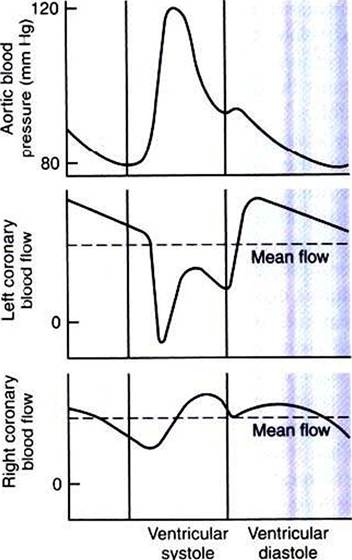
FIGURE 24-5 Coronary blood flow to the left ventricular muscle is greatly reduced during ventricular systole by mechanical compression of the left ventricular blood vessels. Coronary blood flow to the right ventricular muscle is less affected by mechanical compression.