Skin
The skin covers the body and protects it against injury. Skin plays an important part in temperature control and enables the animal to respond to various external stimuli by virtue of its many nerve endings.
There are numerous local modifications of skin (see Chapter 10), but at present, we are concerned only with its more general properties.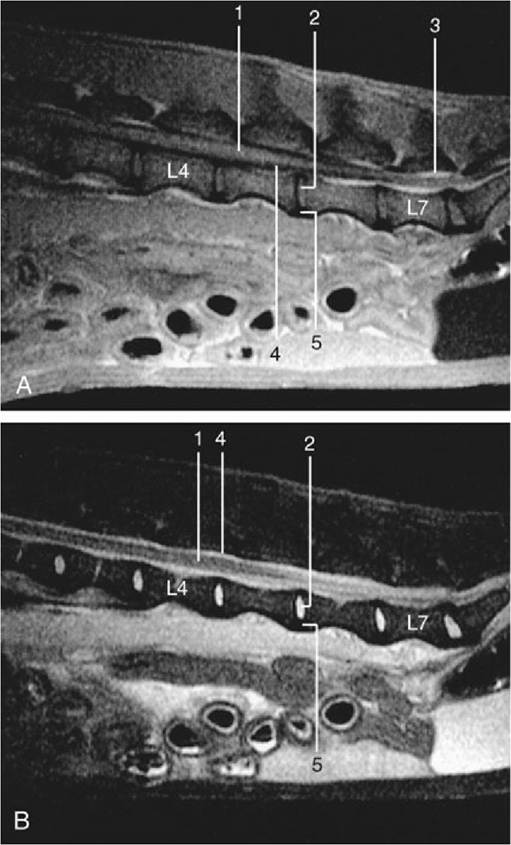
FIG. 1.6 Midsagittal images of 3-mm-thick spin-echo magnetic resonance slices of the canine lumbar vertebral column. (A) T1-weighted (fat appears white, fluids dark). (B) T2-weighted (fluids appear white, fat darker than on T1-weighted images). 1, Spinal cord; 2, nucleus pulposus; 3, epidural fat; 4, cerebrospinal fluid; 5, annulus fibrosus.
The skin varies greatly in thickness and flexibility, both among species and within the same animal. It is naturally thicker in larger animals (though not in constant proportion to their size) and in more exposed areas. Although the skin is generally closely molded to the underlying structures, it forms folds and creases to increase surface area in certain areas to allow for change in posture, heat dissipation, and sometimes an expression of breeders' whims, grotesquely illustrated by the Shar-Pei breed of dog.
Skin consists of an outer epidermis and an inner dermis, and in most situations it rests on a looser connective tissue variously known as the subcutis, hypodermis, or superficial fascia (Fig. 1.7). The epidermis is a stratified squamous epithelium, and its thickness responds to rough usage, as exemplified by the footpads of dogs and cats. This layer is modified in many ways, including the occurrence of sweat and sebaceous glands, which are widely spread, and of hair. Sweat glands are most important as a provision for heat loss by surface evaporation but also play a subsidiary role in the excretion of waste. The sebaceous glands produce an oily secretion that waterproofs the surface and provides certain relatively naked areas, such as the groin of horses, with a characteristic sheen.
The haircoat, which is a uniquely mammalian feature, is a mechanical protection and a thermal insulator. The haircoat is also usually widespread. Among the more familiar species, only the human and the pig are relatively devoid of extensive haircoat, although such conditions may appear in other species as occasional "sports," which is the origin, for example, of the Sphynx breed of cat. Some aquatic mammals, such as whales, are wholly naked.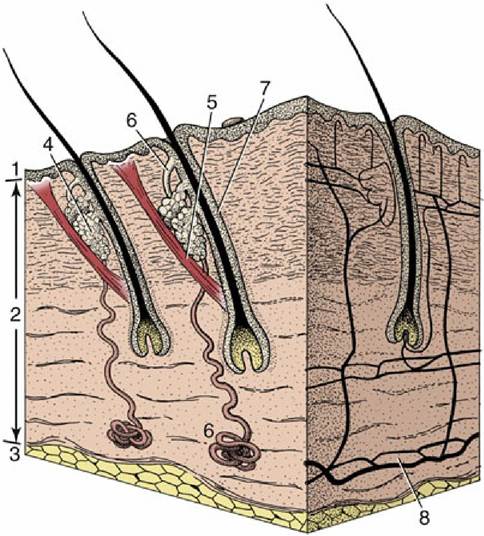
FIG. 1.7 A block of skin. 1, Epidermis; 2, dermis; 3, subcutis; 4, sebaceous gland; 5, arrector pili muscle;
6, sweat gland; 7, hair follicle; 8, arterial networks.
The dermis, which consists essentially of felted connective tissue fibers, is the raw material of leather. It is secured to the epidermis by interlocking papillae, which are most pronounced where normal wear might risk separation. In most situations, the skin moves easily over the underlying tissues, and this looseness facilitates the flaying of a carcass. It is more tightly bound down in a few places where it grades into a tougher-than-usual underlying fascia; good examples of this binding are provided by the scrotum and the lips. Some risk of pressure injury is present where the dermis is molded over bony prominences, and synovial bursae (p. 22) often develop adventitiously in such sites. Unlike the epidermis, the dermis is well supplied with blood vessels (see Fig. 1.7) and cutaneous nerves.
The superficial fascia is considered in the following section.