The upper lip of the llama and alpaca should protrude slightly.
It is split in a manner similar to that of small ruminants, which improves prehension. The nostrils do not have rigid support because the nasal bones are relatively short, and there are no alar cartilages.
Camels can in fact completely close their nostrils with muscle contraction to protect against blowing sand (Fig. 38.9), but llamas and alpacas lack this ability.Specific information about superficial structures of the head is very limited in the literature. The muscles of facial expression are assumed to follow the typical mammalian pattern. The facial nerve is superficial and vulnerable. Camelids have salivary glands typical of other species. The parotid, mandibular, and sublingual salivary glands are the major glands, and they also have minor salivary glands in the oral cavity. The parotid duct also runs across the surface of the masseter, 1 to 1.5 cm dorsal to the facial vein, and opens opposite the rostral end of the upper first molar. Lymph nodes are generally not palpable.
z‰z
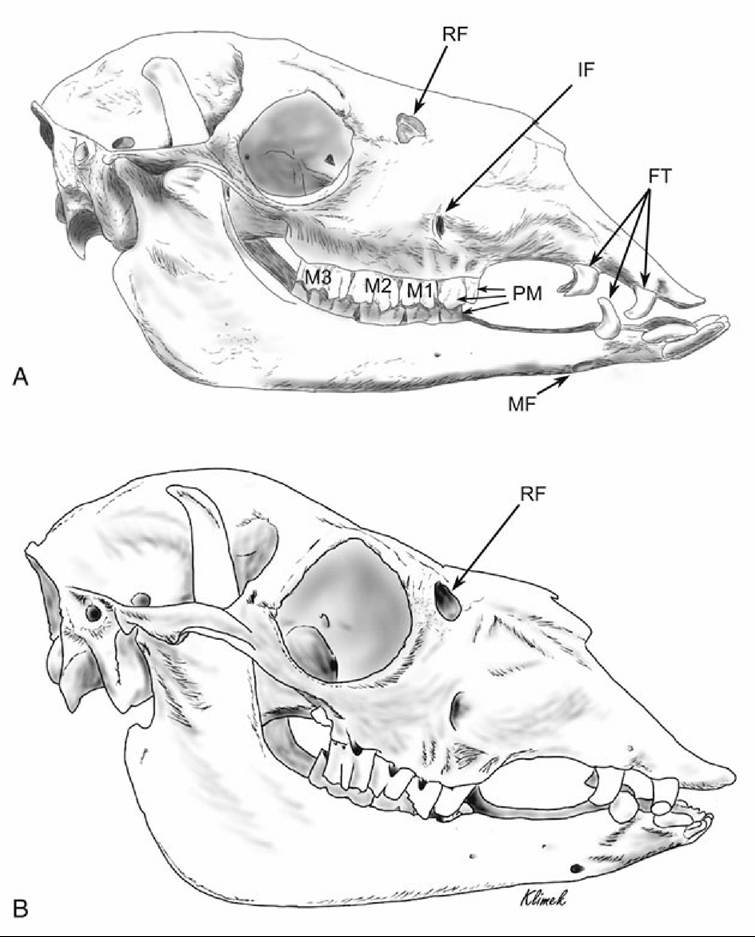
FIG. 38.7 (A) Llama skull. (B) Alpaca skull. FT, “Fighting teeth”; IF, infraorbital foramen; M1 to M3,
molars 1 to 3; MF, mental foramen; PM, premolars; RF, “rostral foramen.” Premolars in the upper arcade are rostral to the infraorbital foramen and are smaller than the molars. Molars increase in size from rostral to caudal.
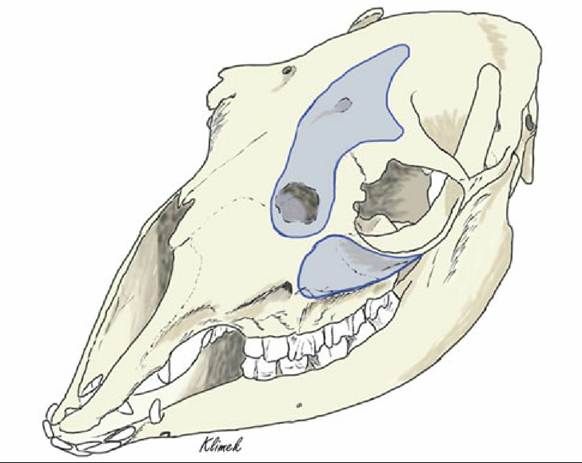
FIG. 38.8 Llama skull with frontal (upper) and maxillary (lower) sinuses shaded in blue.