THE ADRENAL GLANDS AND KIDNEYS
The yellowish-white adrenal glands (see also pp. 221-222 and 174-181) (Figure 14-21/7,7') of the dog are dorso- ventrally flattened, about 2 to 3 cm long and 1 cm wide.
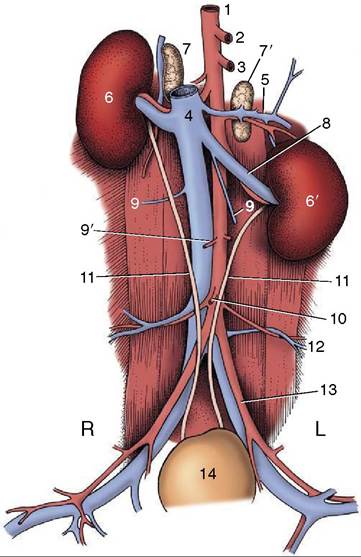
Figure 14-21 The canine urinary organs and adjacent blood vessels in situ.
1, Aorta; 2, celiac a.; 3, cranial mesenteric a.; 4, caudal vena cava; 5, phrenicoabdominal vessels; 6, 6', right and left kidneys; 7,7’, right and left adrenal glands; 8, left renal vessels; 9, ovarian vv.; 9', ovarian aa.; 10, caudal mesenteric a.; 11, ureters; 12, deep circumflex iliac vessels; 13, external iliac vessels; 14, bladder.Each occupies the retroperitoneal space medial to the kidney, cranial to the renal vessels, and dorsolateral to the aorta (the left one) or the caudal vena cava (the right one). The capsule of the right adrenal gland may be continuous with the tunica externa of the vena cava. The right adrenal gland is located ventral to the transverse process of the last thoracic vertebra, with its cranial two thirds covered by the caudate process of the liver. The left adrenal gland, which has a somewhat dorsoventrally flattened oval cranial portion and a cylindrical caudal projection, is positioned ventral to the transverse process of the second lumbar vertebra, just caudal to the origin of the cranial mesenteric artery and adjacent to the origin of the phrenicoabdominal artery. This paired artery courses on the dorsal surface of both left and right glands. The ventral surfaces are crossed and indented by the phrenicoabdominal veins; on the left, this surface is also related to the pancreas.
The glands are diffusely supplied by branches from adjacent vessels: the aorta and the renal, phrenicoab- dominal, lumbar, and cranial mesenteric arteries. The right adrenal vein directly supplies the vena cava, while the left adrenal vein supplies the left renal vein.
The nerve supply is derived from a dense network on the dorsal surface of the glands that appears continuous with the nearby celiac and mesenteric plexuses. The fibers that actually enter the glands are preganglionic and are provided by the splanchnic nerves that enter the abdominal cavity close by.
In cats the adrenal glands are shorter and similar to oval disks. The adrenal glands of older cats are occasionally calcified and are then visible on radiographs. The topography is the same in both species.