The Arterial Baroreceptor Reflex Regulates Arterial Blood Pressure
Arterial blood pressure is monitored by pressure-sensitive nerve endings known as Iuiroreceptors. The baroreceptors send afferent impulses to the central nervous system (CNS), which reflexively alters cardiac output and vascular resistance (in noncritical organs) to keep blood pressure at a set point.
The reflex is called the arterial baroreceptor reflex.The arterial baroreceptors are specialized nerve endings that are embedded in the walls of the carotid arteries and aortic arch (Figure 25-1). The baroreceptors are concentrated at the origin of each internal carotid artery in enlarged parts of the arteries called the carotid sinuses. Similar nerve endings are found in the wall of the aortic arch, especially at the origin of its major branches. These nerve endings are sensitive to stretch (distention) of the arterial wall. In effect, they sense arterial pressure because blood pressure is the natural force that distends these arteries. 'Fherefore, these nerve endings are called baroreceptors (literally, “pressure sensors”), even though the actual physical factor being sensed is not pressure but rather stretch or distortion.
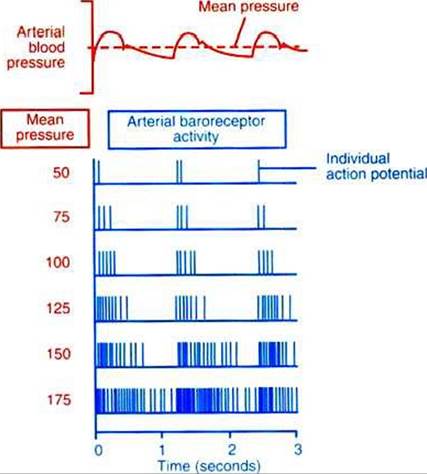
FIGURE 25-2 Each arterial pressure pulse causes action potentials to be generated in baroreceptor afferent neurons. The number of action potentials generated per heartbeat increases dramatically with increases in mean arterial pressure.
With every systolic ejection from the heart, blood distends the aorta and arteries, including the carotid sinuses, which causes the baroreceptors to initiate neural impulses (action potentials). Figure 25-2 illustrates that the frequency of these impulses is proportional to the arterial blood pressure. The tracing on the top shows the pulsatile arterial pressure on three successive heartbeats.
The mean level of arterial pressure is indicated by the dashed line. The tracings below depict the typical patterns of action potentials that would be seen in a baroreceptor afferent neuron for various levels of mean arterial pressure (MAP). When MAP is lower than normal (e.g., 50 mm Hg), there are only one or two action potentials with each heartbeat. These action potentials occur during the rapid upstroke of the pressure wave, because the baroreceptors are sensitive to the rate of change of pressure as well as to mean pressure. When MAP is at a higher level (e.g., 75 mm Hg), more action potentials are formed during each heartbeat, but the action potentials still tend to occur during the rapid pressure increase at the beginning of the cardiac ejection. The higher the MAP, the more action potentials are formed in each heartbeat. Thus the arterial baroreceptors signal increases in pressure by increasing their action potential frequency. Because the baroreceptors are active when arterial pressure is normal (MAP near 100 mm Hg), they can also signal a decrease in arterial pressure by decreasing their action potential frequency.The afferent neurons from the aortic arch baroreceptors run in the vagus nerves (see Figure 25-1). In some species the aortic baroreceptor afferents form a distinct bundle within the vagal nerve sheath, called the aortic depressor nerve. The
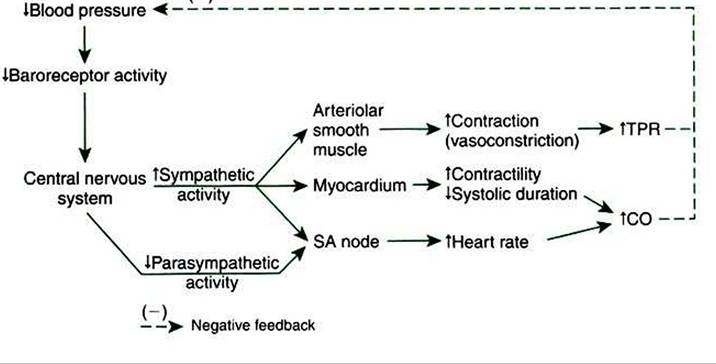
FIGURE 25-3 The arterial baroreceptor reflex responds to decreases in blood pressure (top left) by increasing cardiac output (CO), total peripheral resistance (TPR), or both (far right).These reflex effects offset the initial fall in blood pressure (dashed line). SA, Sinoatrial.
stretch receptors in the carotid sinuses have their afferents in the carotid sinus nerves (Herings nerves)» which join into the glossopharyngeal (ninth cranial) nerve. By way of these afferent neurons, the brain receives beat-by-beat information about the level of arterial blood pressure.
Figure 25-3 summarizes the reflex consequences of a decrease in blood pressure, which decreases afferent baroreceptor activity. The brain responds to a decrease in the afferent activity from the baroreceptors by increasing sympathetic activity. In the heart, sympathetic activation results in increased stroke volume and heart rate, which increases cardiac output. The increase in cardiac output helps to restore blood pressure toward normal. The sympathetically driven increase in heart rate is augmented by a simultaneous reduction in parasympathetic activity to the sinoatrial node. Thus the baroreceptor reflex uses reciprocal changes in sympathetic and parasympathetic activity to control heart rate. Sympathetic activity is also increased to the arterioles of all organs, but particularly to the arterioles of noncritical organs (kidney, splanchnic organs, and resting skeletal muscle). Sympathetic activation causes vasoconstriction of these arterioles, which increases the resistance to blood flow through these organs and therefore increases TPR. The increase in peripheral resistance helps to restore arterial blood pressure back toward its normal level and directs blood flow to the critical organs.
To understand fully the function of the baroreceptor reflex, it is important to recognize that the reflex does not reverse disturbances in blood pressure but only minimizes them. Also, it is important to distinguish between cause and effect when thinking about the baroreflex. For example, what causes blood pressure to decrease below normal is a decrease below normal in cardiac output, TPR, or both. There is no other way to lower blood pressure. When TPR falls below normal and causes blood pressure to decrease below normal, the compensatory response of the baroreceptor reflex is (1) to increase cardiac output above normal through increased sympathetic (and decreased parasympathetic) activation of the heart and (2) to minimize the decrease in peripheral resistance by initiating a sympathetic vasoconstriction in the noncritical organs.
After compensation by the baroreceptor reflex, cardiac output is above normal. TPR is still below normal, but not as far below normal as in the uncompensated state. Blood pressure is still below normal, but not as far below normal as in the uncompensated state.All the reflex responses just described for a decrease in arterial blood pressure occur in reverse in response to an increase in arterial blood pressure above its normal level. Thus the baroreceptor reflex acts to counteract and minimize both decreases and increases in blood pressure.
As a regulator of arterial blood pressure, the baroreflex is both rapid and powerful. It can initiate compensations for changes in blood pressure within 1 second. A hemorrhage that would decrease blood pressure by 40 to 50 mm Hg if there were no baroreflex decreases blood pressure by only 10 to 15 mm Hg in an animal with intact baroreflexes. The baroreflex also acts to maintain blood pressure close to normal during changes in posture or activity. In a dog without baroreflexes, changes in posture are accompanied by large, uncontrolled variations in blood pressure, as shown in Figure 25-4. By minimizing fluctuations in blood pressure, the baroreflex functions to ensure an adequate blood flow to the critical organs.
Although the baroreceptor reflex is essential for the moment-to-moment stability of blood pressure, it does not
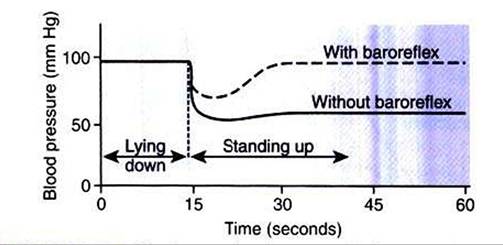
FIGURE 25-4 The baroreflex is essential for normal, moment-to-moment stability of blood pressure. Dogs in which baroreflexes are eliminated exhibit much larger swings in blood pressure in response to postural changes than do dogs with intact baroreflexes.
appear to be the major mechanism responsible for setting the long-term level of arterial blood pressure, because baroreceptors adapt slowly or reset to the prevailing level of arterial pressure. In other words, the baroreceptors come to accept whatever the prevailing blood pressure is as if it were the normal pressure. Baroreceptor resetting causes the baroreflex to “lose track of” normal blood pressure. For example, in an animal or a human who has been hypertensive for a few days or weeks, the baroreflex functions to regulate blood pressure at the elevated level rather than to restore blood pressure toward its normal level. Also, the baroreflex can become reset in a downward direction during a period of sustained hypotension. For example, in chronic heart failure, in which arterial pressure may be below normal for days or weeks, the baroreflex appears to regulate blood pressure at a depressed level rather than to push it back toward its normal level.
In summary, the baroreflex responds quickly and powerfully to counteract sudden changes in blood pressure, but it has little influence on the long-term level of blood pressure over days or weeks.