The Atrial Volume Receptor Reflex Regulates Blood Volume and Helps to Stabilize Blood Pressure
The atrial volume receptor reflex is initiated by specialized sensory nerve endings that are located in the walls of the left and right atria (see Figure 25-1). These nerve endings are activated by stretch, but they are called volume receptors because the volume of blood in each atrium determines how much the atrial wall is stretched.
For example, a decrease in the total blood volume of an animal (e.g., hemorrhage) results in a decrease in the amount of blood in the major veins and in the atria. When atrial volume decreases, atrial pressure decreases, as does the stretch on the atrial walls. This decreases the frequency of action potentials generated in atrial stretch receptors. Conversely, increases in blood volume result in increased atrial stretch and an increased frequency of action potentials generated by the atrial stretch receptors. Therefore, these atrial stretch receptors are sensitive detectors of atrial blood volume and, indirectly, of total blood volume.Figure 25-5 summarizes the reflex effects of a change in the activity of the atrial volume receptors. Ifblood volume decreases, the result is a decrease in the afferent activity from the atrial volume receptors. The CNS responds reflexively to this decreased afferent activity by increasing sympathetic efferent activity to the heart and systemic arterioles and decreasing parasympathetic efferent activity to the heart. In this respect, the atrial volume receptor reflex and the baroreceptor reflex exert synergistic effects; that is, through the atrial volume receptor reflex a decrease in blood volume leads to the same responses that are triggered by the baroreflex in response to a decrease in arterial blood pressure. In both cases the reflex responses include an increase in cardiac contractility, a decrease in systolic duration, and an increase in heart rate as well as arteriolar vasoconstriction in the noncritical organs.
By initiating these responses, the atrial volume receptor reflex helps to combat the decrease in arterial blood pressure that would otherwise result from a decreased blood volume. In effect, the atrial volume receptor reflex augments the effectiveness of the baroreceptor reflex as a regulator of blood pressure.The volume receptor reflex also acts in three additional ways to help restore lost blood volume (Figure 25-5). First, the reflex acts through the hypothalamus to increase the sensation of thirst. If water is available, the animal drinks. This provides the fluid necessary to increase blood volume back toward normal. Second, the atrial volume receptor reflex acts through the hypothalamus and pituitary gland to increase the release of antidiuretic hormone (ADH). ADH is synthesized in hypothalamic neurons, which transport it to the posterior pituitary gland. From there, ADH is released into the bloodstream (see Chapter 33). ADH acts on the kidneys to decrease urine production. Another name for ADH is arginine vasopressin (AVP). The third effect of the atrial volume receptor reflex on blood volume is to increase the release of the hormone renin from the kidneys. Renin acts to increase the production of the hormone angiotensin IIt which acts to increase production of the hormone aldosterone, which acts to decrease the amount of sodium excreted by the kidneys; that is, activation of the renin-angiotensin-aldosterone system causes the body to conserve available sodium.
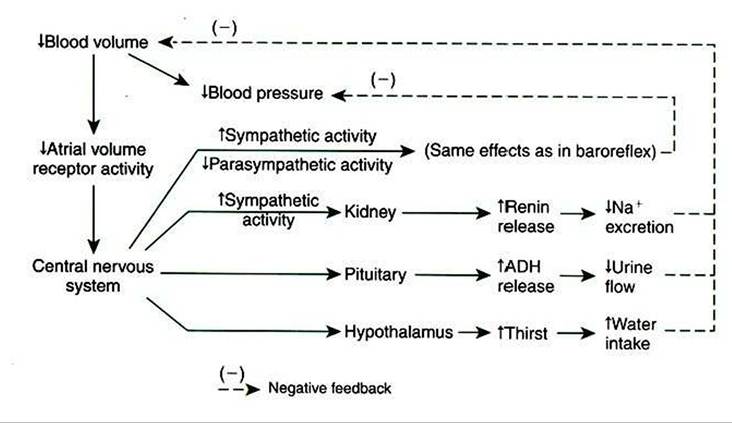
FIGURE 25-5 The atrial volume receptor reflex responds to a decrease in blood volume by decreasing sodium and water loss in the urine and by increasing oral water intake.The reflex also helps support blood pressure by increasing cardiac output and total peripheral resistance (similar to baroreflex). ADHr Antidiuretic hormone.
The combination of decreased sodium excretion (by the actions of renin) and decreased urine flow (by the actions of ADH) results in the conservation of body fluid. The conservation of body fluid, combined with an increased water intake, eventually restores blood volume back toward normal.
Although not diagrammed in Figure 25-3, the arterial baroreceptor reflex also responds to decreases in arterial pressure by increasing thirst, ADH release, and renin release. An increase in arterial pressure above normal initiates the opposite effects. Thus the arterial baroreceptor reflex and the atrial volume receptor reflex are synergistic partners in the interrelated tasks of regulating arterial pressure and blood volume.