The Cerebellum Constantly Compares the Intended Movement with the Actual Movement and Makes Appropriate Adjustments
In performing the essential role of adjusting the timing and coordination of movement, the cerebellum first receives information from components of the motor system hierarchy about the movement it has commanded.
It also receives information from muscle spindles, the vestibular and visual systems, and other sensory receptors about the movement the body is actually performing. When the intended movement and the actual movement are not the same, the cerebellum’s job is to perform the adjustments necessary to make them the same. For example, if the brain intends that a cat move its mouth to a piece of food in a dish, but sensory receptors inform the cerebellum that the trajectory of the head will cause the mouth to miss the dish, the cerebellum makes appropriate adjustments in the components of the motor system hierarchy to correct the head’s trajectory. The correction can be made to the movement in progress and to the plan for subsequent movement.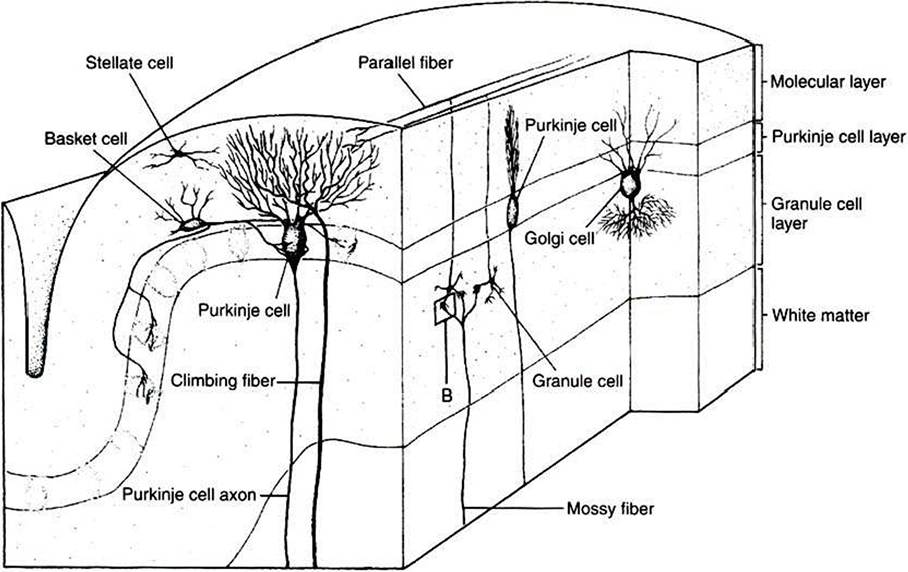
FIGURE 12-2 Five types of neurons are organized into three layers in the cerebellar cortex. A single cerebellar folium is sectioned vertically, in both longitudinal and transverse planes, to illustrate the general organization of the cerebellar cortex. (From Kandel ER, Schwartz JH: Principles of neural science, ed 2, NewYork, 1985, Elsevier Science Publishing.)
This chapter describes cerebellar histology and phylogenetic anatomy as clues to cerebellar function. Movement disorders resulting from lesions of the cerebellum are described as further clues to the function of this part of the brain.