The Pulmonary Blood VesselsOffer a Low Resistance to Flow
Pulmonary vascular pressures can be measured by advancing a catheter through the jugular vein into the right ventricle and pulmonary artery. Even though the pulmonary circulation receives the total output of the right ventricle, pulmonary arterial pressures are much less than systemic pressures.
Pulmonary arterial systolic, diastolic, and mean pressures average 25, 10, and 15 mm Hg, respectively, in mammals at sea level. If the catheter is advanced until it becomes wedged in a pulmonary artery, the occluded vessel becomes an extension of the catheter, allowing estimation of pulmonary venous pressure, also known as pulmonary wedge pressure. Pulmonary wedge pressure (average, 5 mm Hg) is only slightly greater than left atrial pressure (average, 3-4 mm Hg). The small difference in pressure between the pulmonary artery and left atrium indicates that the pulmonary circulation offers little vascular resistance to blood flow. Pulmonary vascular resistance (PVR) is calculated as follows:
where Ppa is mean pulmonary arterial pressure, Pla is left atrial pressure, and Q is cardiac output.
Although PVR is low in the normal resting animal, it decreases even further when pulmonary blood flow or pulmonary arterial pressure increases, as occurs during exercise. Recruitment of previously unperfused vessels and distention of all vessels cause the PVR decrease.
Micropuncture studies have shown that approximately half the vascular resistance in the pulmonary circulation is precapillary, and that the capillaries themselves provide a con-
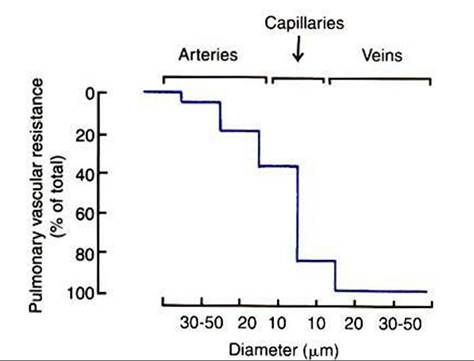
FIGURE 46-3 ■ Distributionofvascularresistanceinthe pulmonary circulation, as determined by micropuncture studies. Unlike the resistance in the systemic circulation, a major portion of the resistance to blood flow in the pulmonary circulation is in the capillary bed. (From Bhattacharya J, Staub NC: Direct measurement of microvascular pressures in the isolated perfused dog lung, Science 210:327, 1980. Copyright © 1980 by the American Association for the Advancement of Science.)
siderable portion of resistance to blood flow (Figure 46-3). Unlike the arterioles in the systemic circulation, the small arteries in the pulmonary circulation neither provide large resistance nor dampen the arterial pulsations; consequently, pulmonary’ capillary blood flow is pulsatile. The pulmonary veins provide little resistance to blood flow.