The footpads (tori) are the cushions on which animals walk.
They are covered by a naked, densely cornified epidermis (see Fig. 10.2). The dermis is unremarkable, and the bulk of their substance is provided by a thick, resilient subcutis, an admixture of collagenous and elastic fibers interspersed with adipose tissue.
Footpads are best developed in plantigrade mammals (e.g., bears), in which digital, metacarpal (metatarsal), and carpal (tarsal) pads are all present (Fig. 10.14). In the digitigrade dog and cat, only digital and metacarpal (metatarsal) pads make ground contact; there is a carpal pad of no obvious use but no corresponding tarsal pad (Fig. 10.15).
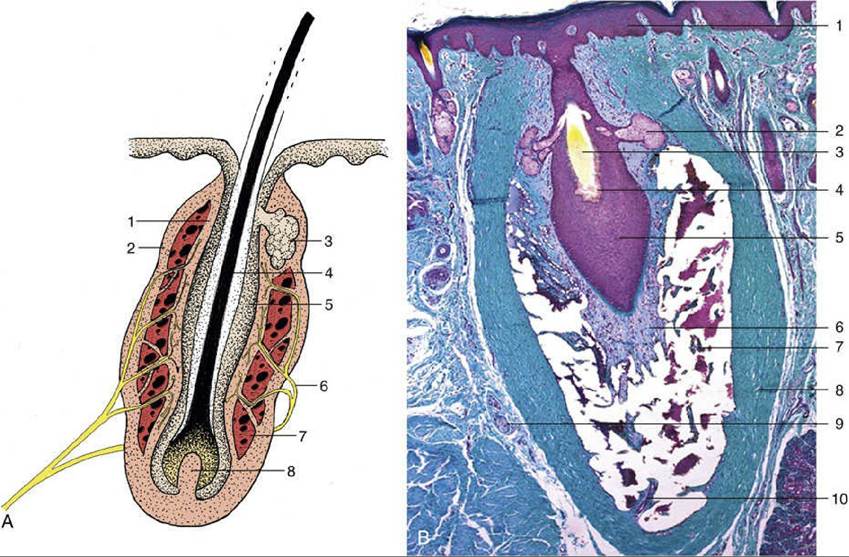
FIG. 10.12 (A) Schematic longitudinal section of a tactile hair follicle. 1 and 2, Internal and external walls of blood sinus; 3, sebaceous gland; 4, root of hair; 5, epidermal wall of hair follicle; 6, nerve ending in wall of blood sinus; 7, blood sinus; 8, dermal papilla. (B) Tactile hair follicle of calf (Crossmon). 1, Epidermis; 2, sebaceous gland; 3, hair; 4 and 5, inner and outer hair root sheath; 6 and 7, trabeculated blood sinus; 8, inner and outer layer dermal sheath; 9, nerve ending; 10, trabecula.
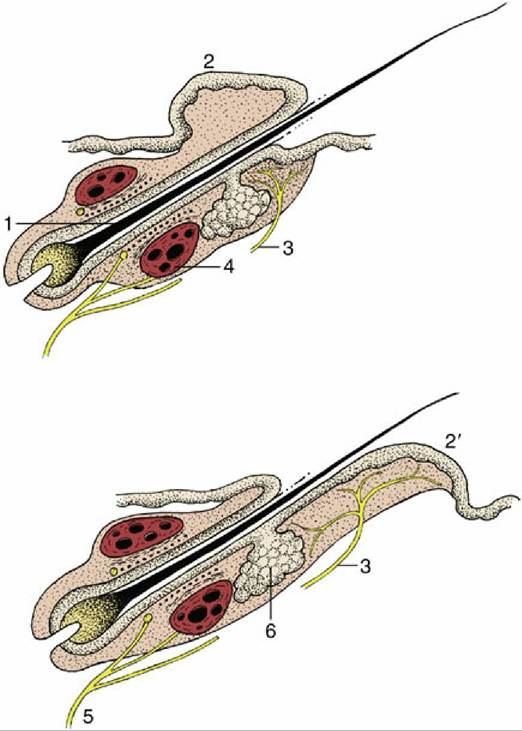
FIG. 10.13 Tylotrich hairs below (top) and above (bottom) tactile elevations (2 and 2'). 1, Root of hair; 3, nerve endings associated with tactile elevations; 4, blood sinus; 5, nerve endings associated with blood sinus; 6, sebaceous gland.
Only digital pads, called bulb in ruminants and pigs and frog in horses, located in the hoof are functional and in contact with the ground in ungulates. The bulbs of the pig are softer than those of ruminants and well set off from the sole (see later) (Fig. 10.16/1).
The digital cushion (pulvinus digitalis) deep to the frog of the horse consists of an apex and a base. The apex lies deep to the horny frog on the ground surface of the hoof (Fig. 10.17/4), whereas the base helps shape the palmar (plantar) surface, forming the swellings at the heels. These, the bulbs of the heels (Fig. 10.17/3), do not make contact with the ground and are covered by periople, the softer horn produced at the junction of the skin with the wall of the hoof. The horse, unlike the other domestic ungulates, also has rudimentary metacarpal (metatarsal) pads ("ergots"; Fig. 10.17/2) embedded in a tuft of hair behind the fetlock joint and vestigial carpal (tarsal) pads (chestnuts; Fig. 10.17/1 and 1').
The subcutis of the canine footpads, porcine bulbs, and equine frog contains sweat glands whose ducts channel through the thick, cornified epidermis. The secretions function as territorial or trail markers.