» The Mediastinum (see also pp. 150-151)
The fibrous tissue associated with the thoracic organs and between the pleural sacs (fascia endothoracica) is so thin that the mediastinum is reduced in several places to a very delicate and transparent membrane (Fig.
13.12B) consisting only of apposed right and left pleural sheets. It ruptures easily, and although the two pleural sacs may be regarded as normally independent, most dogs in which pneumothorax has been induced unilaterally show bilateral pneumothorax in radiographs.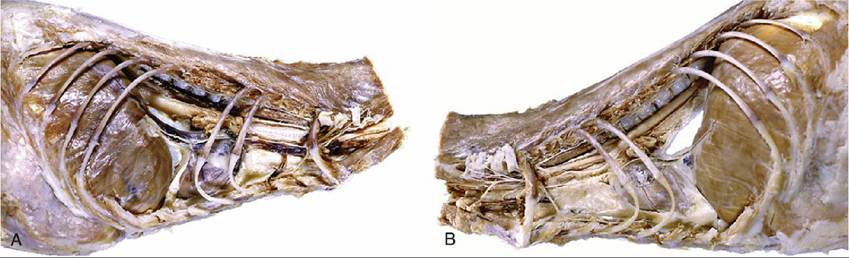
FIG. 13.12 (A) Mediastinum of a cat, right view. In the middle part the heart is the main component. The cranial and caudal mediastinum is thin and, in some places, fragile. (B) Mediastinum, left view. A large opening in the caudal part, probably caused by dissection, indicates the fragility of the structure.
The cranial mediastinum is wide dorsally where it contains the trachea and esophagus, lying side by side as they pass through the thoracic inlet, and the cranial vena cava and brachiocephalic trunk, with their tributaries and branches, embedded in generous quantities of fat. Ventrally the cranial mediastinum contains lymph nodes, the internal thoracic vessels, fat, and, in the young animal, the thymus. This part narrows with the regression of the thymus, providing more space for the apices of the lungs.
The dorsal part of the middle mediastinum is slightly narrower than the heart (Fig. 13.13). It contains the termination of the trachea, the esophagus, the aortic arch, the structures comprising the roots of the lungs, and lymph nodes. Its right surface is flat, but the aorta (Fig. 13.13/4) bulges on the other side to indent the left lung. The middle part at this level contains the heart (within the pericardium), but the ventral part, between the pericardium and sternum, is folded and contains only the phrenicopericardiac ligament, which attaches the pericardium to the sternum and diaphragm more loosely than the corresponding sternopericardiac ligament in larger species.
The triangular dorsal part of the caudal mediastinum contains the aorta and the right azygos vein and, more ventrally, the esophagus (Figs. 13.12A and 13.13; also, Figs. 13.14-13.16). The delicate ventral part runs between the pericardium and the diaphragm, which it approaches along a line that is displaced so far to the left that it reaches the thoracic wall near the ninth costochondral junction. There is the usual recess between the mediastinum and the fold enclosing the caudal vena cava that is occupied by the accessory lobe of the right lung.
The infracardiac bursa is a diverticulum of peritoneum that intrudes through the esophageal hiatus of the diaphragm to lie against the right face of the esophagus, extending from the diaphragm to the root of the lung. It is the occasional recipient of a herniated part of an abdominal organ, either as a congenital anomaly or as the result of trauma.