THE OLFACTORY ORGAN
The sense of smell is much better developed in the domestic mammals than in ourselves; this is particularly true of the dog, which can detect airborne substances in incredibly low concentrations.
Much of the “contact” with the environment and with other animals is made through this sense, and the examples given here underscore the importance of olfaction in animal life. This capability is exploited when dogs are used to “point” at game, to follow a scent in tracking fugitives (or detect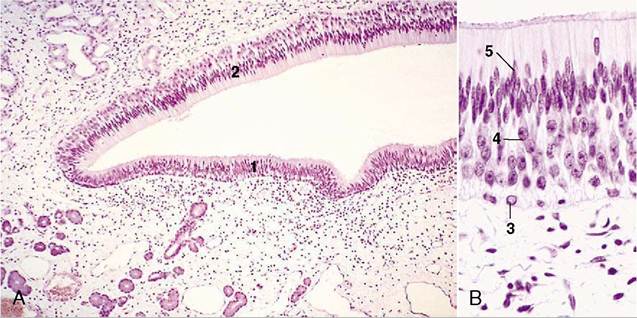
Figure 9-30 A, Vomeronasal organ (pig) (HE) (70?). B, Vomeronasal organ (pig) (HE) (279?). 1, Ciliated pseudostratified columnar respiratory epithelium; 2, pseudostratified columnar epithelium of basal; 3, ciliated sustentacular; 4, and neurosensitive; 5, cells.
drugs and explosives), and when dogs and pigs are trained to find buried truffles. Dams recognize their offspring largely by the sense of smell, wild animals identify the extent of their territory by odorants on the ground, and wild herbivores test the air for the scent of predators.
The olfactory organ is of course situated in the nose. In animals with a well-developed sense of smell, it consists of a relatively large area of olfactory mucosa covering the lateral wall and the ethmoidal conchae in the caudal part of the nasal cavity. Although claimed to be a little more yellowish than the respiratory mucosa rostral to it, the olfactory mucosa cannot convincingly be identified by gross inspection. Histological sections show the presence of olfactory cells that, like the lightreceptor cells in the retina, are bipolar neurons. Their dendrites reach the surface of the epithelium, presenting several minute olfactory hairs (cilia) to the air in the nasal cavity. The axons of the cells combine to form the fascicles of the olfactory nerve (cranial nerve I) that pass through the cribriform plate to the nearby olfactory bulb.
Serous olfactory glands below the olfactory epithelium moisten the surface of the epithelium, presumably to wash away previously perceived odorants no longer present in the air.The vomeronasal organ found in the nasal cavity is also concerned with olfaction. It consists of two narrow, parallel ducts that are embedded in the hard palate, one to each side of its junction with the nasal septum. The ducts, which are supported laterally, ventrally, and medially by thin cartilages, are lined in part with olfactory mucosa (Figure 9-30, A-B). Caudally they end blindly, but rostrally they open into the incisive ducts, which in most mammals connect the nasal and oral cavities through openings in the hard palate. The communication with the oral cavity is lacking in horses and donkeys. This organ has received considerable attention from animal behaviorists and reproductive physiologists because of its involvement in sexual activity, particularly in the lip-curl (Flehmen) reaction demonstrated by male animals aroused by the odor of vaginal secretion or urine from estrous females (Figure 9-31, A-B). Whether the Flehmen reaction as well as the accompanying extension of the head helps the odorants reach the vomeronasal organ is still a matter of speculation. Experimental blockage of the incisive ducts modifies but does not eliminate the Flehmen reaction and other responses of bulls exposed to the pheromones contained within the vaginal secretion of cows in heat.