THE PROCESS OF TESTICULAR DESCENT
The descent of the testis into a scrotal position is necessary in most mammals to obtain normal fertility. The process depends on the existence of a mesenchymal condensation, the gubernaculum testis, within a detachment from the genital fold that leads from the testis toward and through the inguinal canal (Figure 5-18).
At a certain critical period of development (which varies in timing among different species) the distal part of the gubernaculum, which extends through the inguinal canal to the groin, enlarges very rapidly and considerably (Figure 5-19, A-B). The gubernaculum is invaded by an extension of the peritoneal lining of the abdomen. In this way the vaginal process, which provides the space into which the testis will be drawn, is formed (Figure 5-18/3). The invasion by the vaginal process divides the gubernaculum into three parts: the proximal part (pars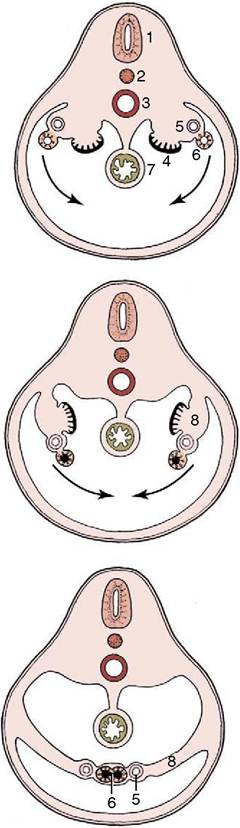
Figure 5-14 Transverse sections (from cranial to caudal) through the caudal part of the abdomen, illustrating the creation of the genital fold in the female embryo. 1, Neural tube; 2, notochord; 3, aorta; 4, gonad; 5, mesonephric duct (regressing); 6, paramesonephric duct (merged in the caudal section); 7, gut; 8, genital fold.
canal) is as thick as the testis itself (see Figure 5-19, A-B). At this stage any slight increase in intraabdominal pressure may be sufficient to expel the testis from the abdomen into the inguinal canal, although for a time its return to the abdomen is still possible. The descent is complete and irreversible once the core of the gubernaculum has regressed (Figure 5-20). A well-timed gubernacular regression is therefore as indispensable to normal descent as is the earlier swelling. Because the timing is critical and the process is subject to various disturbances, it is not surprising that abdominal retention and abnormal descent are both relatively frequent.
Failure of the testis to appear in the groin is known as cryptorchidism (hidden testis). It takes various forms: it may be unilateral or bilateral and may present the testis held within the abdomen or trapped within the inguinal canal. As a result of the higher temperature to which an undescended testis is exposed, spermatogenesis is not initiated at puberty. The condition is clearly undesirable and, although unilaterally cryptorchid animals may be fertile, they should be excluded from breeding because the condition is often hereditary.Similar structures are formed in the female sex but do not develop significantly, except in the bitch among domestic mammals, in which the existence of the vaginal process is occasionally troublesome (p. 461).
In several species when a twin pregnancy occurs, the circulation of the two fetuses can become interconnected, which results in not only the exchange of cells but also hormones (Figure 29-18). The hormonal influence of the male fetus can interfere with the development of the female co-twin. In cattle this can result in a “freemartin,” in which the ovary and the female duct system is severely underdeveloped or absent. It can also result in the outgrowth of the gubernacula in the female twin (see Figure 35-8, A-B). Very seldom, this can also occur in a pig fetus that is interconnected with a male fetus in utero.
THE URINARY ORGANS
propria) is enclosed by the inner (future visceral) peritoneal lining of the process; the second part (pars vaginalis) surrounds the outer (future parietal) peritoneal lining of the process; and the third part (pars infravagi- nalis) lies distal to the invagination and is thus continuous with the other parts. The swelling of the gubernaculum commences distally, causing it to exert pressure on the body wall about the superficial ring of the inguinal canal. This displaces the testis distally, toward the abdominal entrance of the canal. The swelling then gradually extends proximally, and at its peak the part adjacent to the testis (and within the inguinal The urinary system comprises paired kidneys that form the urine from the blood; ureters that convey the urine from the kidneys; the bladder, where urine is stored until it can be discharged conveniently; and the urethra, through which it finally passes to the exterior. As almost the entire male urethra also conveys the reproductive products, it is usual to describe it with the reproductive organs.