THE RENAL PELVIS AND URETER
In cattle the ureter is formed by the coming together of the short passages that lead from the calices that enclose individual renal papillae (Figure 5-24, B and Figure 28-27). In most domestic species the ureter begins in a common expansion, the renal pelvis, into which all the papillary ducts open—although in different ways in different species (see Figures 5-24 and 21-23).
Few differences in pelvic anatomy are of practical significance. However, in the dog and cat the form of the renal pelvis obtains an importance lacking in the other species from its ready depiction in radiographs. The renal pelvis of these animals is molded on the renal crest and extends flanges dorsal and ventral to this. Each flange shows a number of local expansions or recesses that are divided from each other by projections of renal tissue (Figure 5-29). Neighboring recesses are also separated by the interlobar vessels.The remaining tubular part of each ureter has a fairly even caliber. It follows a broadly sagittal course
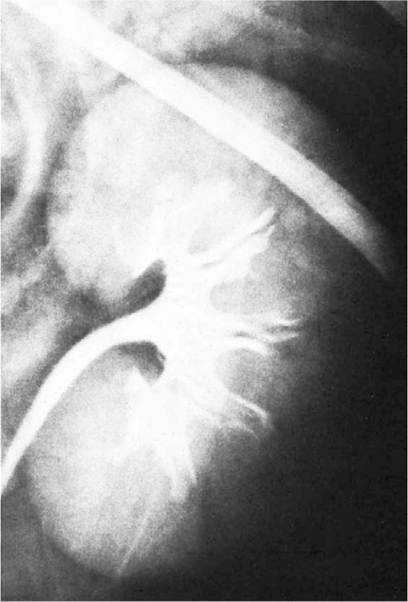
Figure 5-29 Radiograph of renal pelvis of the dog. Note the pelvic recesses.
against the abdominal roof, although it may exhibit occasional sharp changes in direction. On reaching the pelvic cavity the ureter bends medially to enter the genital fold in the male or the broad ligament in the female; this carries the ureter over the dorsal surface of the bladder, into which it opens near the neck (Figure 5-30). In the male the ureter passes dorsal to the corresponding deferent duct.
The ureter penetrates the bladder wall very obliquely. The length of the intramural course guards against reflux of urine into the ureter when the pressure is raised within the bladder (Figure 5-31). It does not prevent further filling of the bladder because the resistance is overcome by peristaltic contractions of the ureteric wall. The wall of the renal pelvis and ureter possesses an external adventitia, a middle muscularis, and an internal mucosa. The muscle coat is well developed, and although its peristalsis helps move urine to the bladder, it can enter spasm when provoked by local irritation such as is provided by a urinary calculus.