The Reproductive Tract During Pregnancy
The ovaries, continue to show cyclical activity during the first months of pregnancy. Although the first corpus luteum does not persist beyond the usual term, it is replaced by a succession of other corpora over the next 5 months; some are formed after rupture of follicles, others apparently by direct luteinization.
The accessory corpora lutea survive longer than the original one and are a rich source of progesterone. The growth, ripening, and luteinization of the new follicles are controlled by gonadotropic hormones derived from the endometrial cups that are so distinctive a feature of the species. After 5 months the accessory corpora lutea also regress and pregnancy is then maintained by progesterone of placental origin. The enormous enlargement of the fetal gonads, peculiar to the horse among domestic species, reaches a peak between 6 and 8 months. Despite assertions that fetal hypophyseal luteinizing hormone is responsible for the enlargement, the endometrial gonadotropins also contribute (see Fig. 22.18B). The temporary enlargement of the fetal testes influences the timing and the success of their descent, which is normally completed about full term.Early Pregnancy Diagnosis: The pregnancy is mainly diagnosed through careful internal examination per rectum, supplemented by ultrasonography (Fig. 22.16). The rectal examination will reveal a closed cervix as early as 16 to 18 days post ovulation. The uterine walls show tone under the influence of progesterone between 12 and 25 days and become soft after 48 to 50 days. The conceptus of 30 to 40 mm between 17 and 30 days is within the part of a uterine horn adjacent to the junction with the body of the organ and creates a slight bulge of the ventral aspect of the gravid horn. It increases to a length of 8 to 10 cm and a diameter of 6 to 8 cm by day 50.
Ultrasonic examination may detect a conceptus as early as day 10 post ovulation.
The smaller size of the conceptus at this stage requires very systematic examination to distinguish it from a fluid-filled structure such as an endometrial cyst. The early conceptus enjoys considerable mobility, which also distinguishes it from any pathologic lesion, before adopting a fixed location within the uterus. Most of the equine conceptuses are located within the body of the uterus about the 10th day and settled in a horn a week or so later. Ultrasonography may be employed after 55 days of pregnancy to determine the sex of the fetus, which is revealed by the location of the genital tubercle close to the umbilical cord in the male and nearer the tail in the female.The proliferative changes of the endometrium that occur with each cycle continue and intensify if pregnancy has occurred. The early diagnosis of pregnancy and, because of the prevalence of early embryonic death, the confirmation of its continuation through the critical early stages have particular importance in equine practice. An additional significance is provided by the desirability of recognizing twin pregnancies at an early stage. Twin pregnancies are rarely completed successfully, and the clinician and client may choose to destroy one of the twins by manual crushing before the implantation to lessen the risk of losing a breeding season.
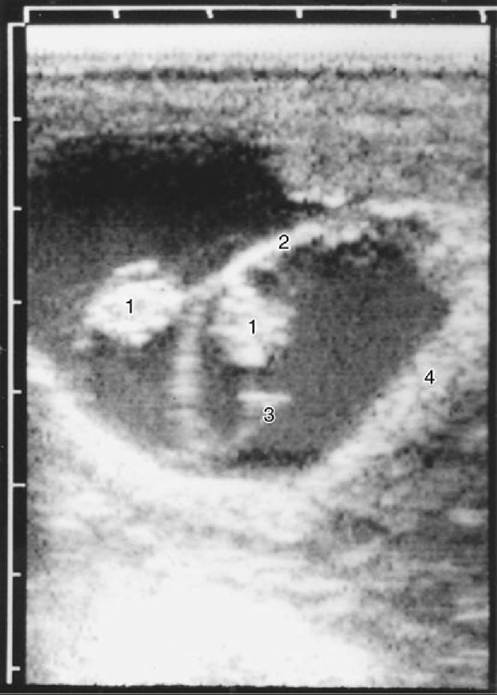
FIG. 22.16 Ultrasonographic view of 31 -day equine twin embryos. The scale is in centimeters. 1, Twin embryos; 2, junction of the two conceptuses; 3, developing allantoic membrane; 4, uterine wall.
After the conceptus settles in the horn, the whole gravid horn (which is more commonly the right one) then gradually enlarges, followed by the body and, although to a lesser degree, the nonpregnant horn. As the uterus enlarges it sinks into the abdomen, dragging the body and the cervix out of the pelvis (Fig. 22.17). The broad ligaments exert constraint on the mesometrial margins, and the horns therefore enlarge asymmetrically and become more flexed on themselves; the ovaries are drawn ventrocranially.
The uterine arteries, which are pulled in the same direction, develop a characteristic vibration (fremitus or thrill) in the pregnant mare. This feature may be appreciated on rectal examination, and its diagnostic value is greatest at that stage of pregnancy (between the third and fifth month) when the uterus has sunk out of reach. The position of the foal adapts to the form of the uterus; by midpregnancy it has come to lie with its back against the greater curvature of the horn (and thus ventrally) and with its head generally (99% of the time) raised toward the cervix. In the circumstances that most favor easy parturition, the bulky body of the foal is preceded into the cervix by the extended forelimbs, on which rest the relatively small head and slender neck. The foal is delivered with its back uppermost. Because of the general enlargement and considerable size of the body of the uterus, it is possible for the occasional fetus to lie transversely, extending from one horn into the other; clearly this bodes ill for parturition. Enlargement of the uterus displaces the other abdominal contents forward and upward; in later pregnancy the uterus dominates the entire abdominal topography, extending forward on the abdominal floor and under the rib cage; however, it generally remains to the left of the cecum.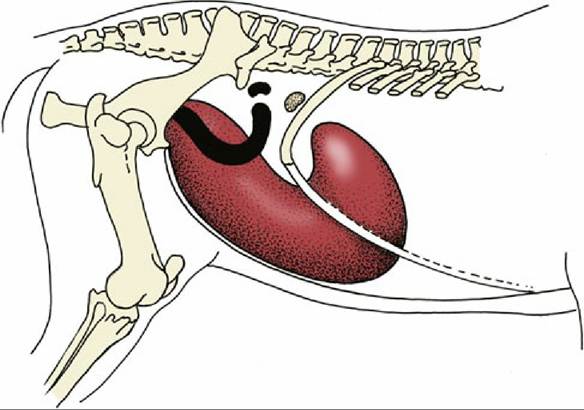
FIG. 22.17 Changes in the topography of the uterus and ovary between the beginning (black) and the end (red) of pregnancy.
A prominent feature of the uterus in early months of pregnancy is the presence of a ring or horseshoe formation of scablike structures, disfiguring the endometrium of the caudal part of the horn, the location where the young conceptus comes to rest. These so-called endometrial cups (Fig. 22.18B) are unique to Equidae and are the source of both equine chorionic gonadotropin (formerly known as pregnant mare's serum gonadotropin [PMSG]), the hormone responsible for the unusual activity of the ovary of the pregnant mare and the even more remarkable, though temporary, enlargement of the gonads of equine fetuses of both sexes.
The cups have their origin in cells that invade the endometrium from a limited region of the chorion: the (allanto-) chorionic girdle that marks the boundary between the allantochorionic and omphalochorionic (yolk sac) portions of the embryonic vesicle and provides the area of initial adhesion of the conceptus to the uterus (Fig. 22.18A). The migration of chorionic cells begins about the 35th day, and the cups soon become visible as low endometrial elevations. They continue to grow, forming irregular centrally depressed prominences that reach their zenith about the 60th day, only to enter a process of degeneration and necrosis shortly thereafter. The process culminates in their separation and sloughing from the endometrium, which are events largely concluded by the 120th day (or thereabouts), although a few may persist much longer. The fetal (chorionic) cells penetrate some way into the endometrial stroma, and although they provide the essential endocrine components of the cups, they become admixed with connective tissue cells, blood vessels, and glandular debris and secretion contributed by the endometrium. Some detached cups come to lie between the endometrium and chorion; other detachments of this material push into the allantoic cavity, enclosed within pedunculated sacs of allantochorion, and these protrusions may be the origin of some of the hippomanes mentioned shortly.The cervix of the pregnant mare is firm and closed by a plug of mucus (Fig. 22.12). The pale vaginal wall is also coated with mucus that becomes stickier and more inspissated as pregnancy progresses. The connective tissues of the cervix, vagina, and vulva and the sacrotuberal ligaments soften shortly before birth, which is generally speedily executed, facilitated by the generous dimensions of the pelvic cavity. It is necessary that it should be so, because rupture of the membranes with loss of fetal fluids allows separation of the loose attachment between the chorion and the endometrium, jeopardizing fetal respiration.
Puerperal changes follow the same pattern as in other species but run a rapid course. Involution of the uterus is completed sooner than in the cow, and because there is no endometrial damage to repair, mares covered at the "foal heat"-about the 8th to 10th day after giving birth—often conceive.
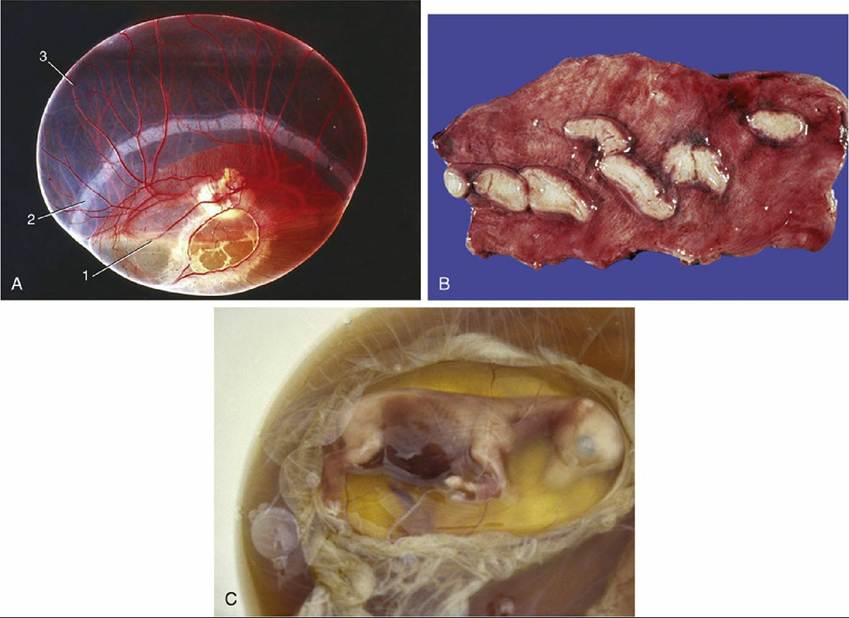
FIG. 22.18 (A) Young conceptus (horse). 1, Yolk sac; 2, chorionic girdle; 3, allantochorion. (B) Endometrial cups (mare) during early pregnancy. (C) The placenta of the horse fetus is not very complex. The villi do not penetrate deep into the endometrium.