The Salivary Glands
Numerous salivary glands, small and large, drain into the oral cavity. Small salivary glands occur in the lips, cheeks, tongue, soft palate, pharynx, and esophagus. Although they are individually unimportant, their collective contribution must be considerable.
However, certain larger glands contribute most of the saliva into the mouth cavity via secretory ducts (Fig. 3.11). Unlike the minor glands, which mostly produce a mucous secretion, some of these major glands produce a more watery (serous) fluid containing the enzyme ptyalin, which plays a minor role in carbohydrate digestion. The saliva keeps the mouth clean and moist, and upon mixing with food, it facilitates mastication and lubricates its passage. It may also contribute to deposition of tartar on teeth.The parotid gland, which is purely serous in most species (though not in the dog), is molded around the ventral part of the auricular cartilage (Fig. 3.12). In the dog it is small and confined to the vicinity of the cartilage. In herbivores, the gland is large and extends rostrally onto the masseter muscle, ventrally toward the angle of the jaw, and caudally toward the atlantal fossa. It produces copious amounts of serous saliva to moisten and soften foods. In all species it is enclosed within a fascial covering that sends trabeculae inward to divide the gland into obvious lobules. The major collecting ducts run within these trabeculae and eventually join to form a single duct that leaves the cranial aspect. In the dog this duct takes the shortcut across the lateral surface of the masseter to open into the vestibule of the mouth opposite the fourth upper premolar tooth. In the large domestic animals the duct takes the longer but more protected route medial to the angle of the jaw and winds below the mandible to enter the face along the rostral margin of the masseter.
The mandibular gland (Fig.
3.11B) produces a mixed mucous and serous secretion. Generally smaller than the parotid, it is more compact and is placed close to the angle of the jaw. It is a moderately large, very regular ovoid structure in the dog. It too is much larger and deeper in herbivores. This gland also drains by a single large duct that runs ventral to the mucous membrane of the floor of the mouth, close to the frenulum of the tongue, to open on the sublingual caruncle.The sublingual gland is also commonly mixed and sometimes consists of parts: one is compact (monostomatic) and drains by a single duct, and the other is diffuse (polystomatic) and opens by several small ducts. In the dog the compact part fits over the rostral extremity of the mandibular gland, which it appears to continue. The sublingual and mandibular ducts travel and open alongside each other; they may even have a common opening. The diffuse part, the only part present in the horse, has a submucosal location in the oral floor and opens via many ducts beside the frenulum.
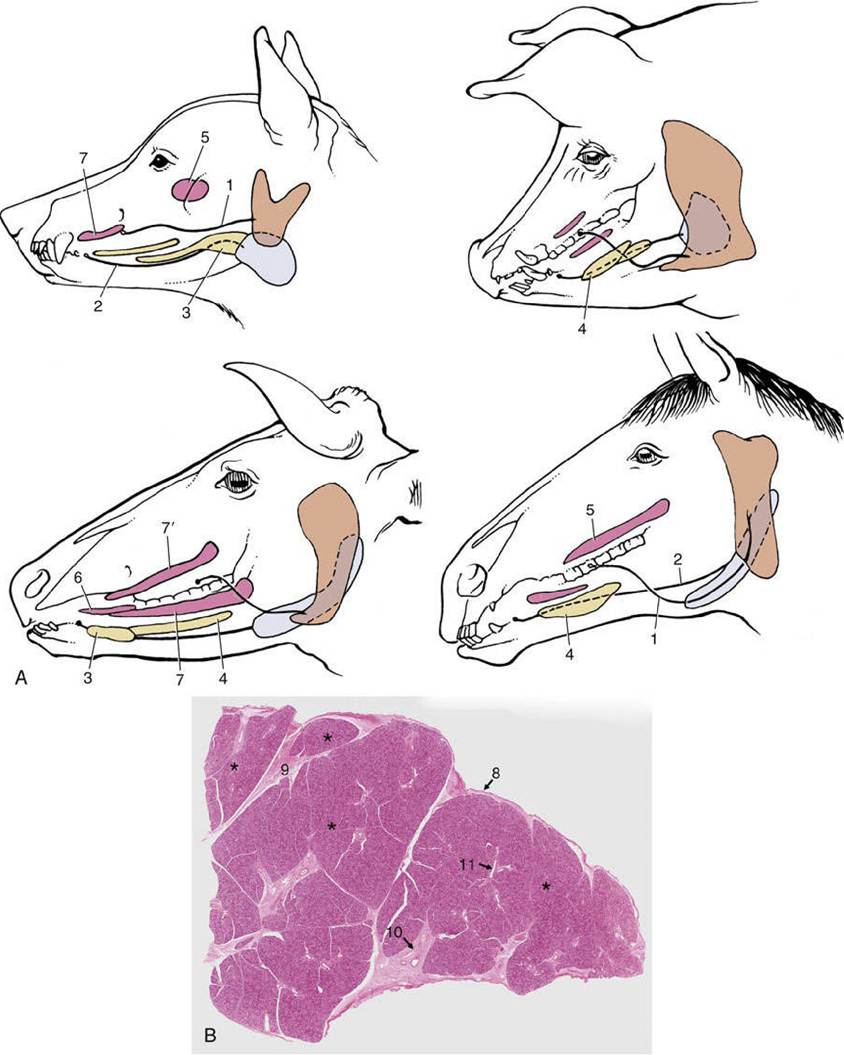
FIG. 3.11 (A) The major salivary glands of the dog, pig, cattle, and horse. Orange, parotid gland; white, mandibular gland; yellow, sublingual glands; red, buccal glands. 1, Parotid duct; 2, mandibular duct; 3, compact (monostomatic) part of sublingual gland; 4, diffuse (polystomatic) part of sublingual gland; 5, dorsal buccal glands (zygomatic gland in the dog); 6, middle buccal glands; 7, ventral buccal glands; 7', middle buccal gland. (B) Mandibular salivary gland of horse. Hematoxylin and eosin stain. This small portion of gland illustrates the organization of the secretory units. Notice that the gland is surrounded by adventitial connective tissue (8), and many lobules (*) are separated by connective tissue septas (9) containing interlobular ducts (10), blood vessels, and nerve bundles. The mixed nature of the horse mandibular gland is evident by the serous (dark purple) and mucous (light pinkish) components present within the same lobule.
Many intralobular or striated ducts (11) are visible among the secretory end-pieces within the lobules (hematoxylin and eosin stain).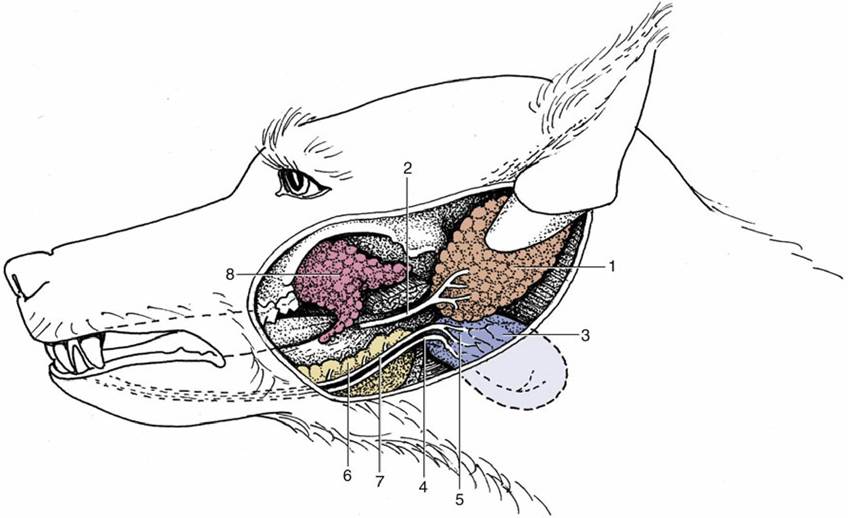
FIG. 3.12 The salivary glands of the dog. 1, Parotid gland; 2, parotid duct; 3, mandibular gland; 4, mandibular duct; 5, caudal part of compact sublingual gland; 6, rostral part of compact sublingual gland; 7, major sublingual duct; 8, zygomatic gland.
The flow of saliva is normally continuous, and although the rate is influenced by many factors it is under neural control. The flow is depressed by anxiety or fear and may be wholly suspended when the body is dehydrated: the resulting dryness of the mouth contributes to the sensation of thirst. It is increased when substances—even inedible ones — are introduced into the mouth, although food is most effective. The saliva production increases even with the anticipation of feeding. The salivary glands receive both sympathetic and parasympathetic supplies, the latter being vastly more important. The parasympathetic fibers come from the two salivatory nuclei of the brainstem and first travel in the facial and glossopharyngeal nerves; later the fibers are carried to their destination in various branches of the trigeminal nerve. The preganglionic fibers synapse close to the gland, and the postganglionic fibers terminate in direct contact with the secretory cells. The parasympathetic stimulation induces copious flow accompanied by vasodilation. Sympathetic stimulation produces vasoconstriction, which slows the rate of production and alters the composition of the saliva.