THE STIFLE JOINT
Although generally conforming to the common pattern, the equine stifle also exhibits several important features of distinction. The most remarkable provide the means of “locking” the joint so that one hindlimb may support a disproportionate part of the body weight and allow the other to be rested while the animal remains standing.
The arrangement is a major component of the passive stay-apparatus (p. 636).The locking mechanism relies on certain peculiarities of the articular surfaces. The femoral trochlea is markedly asymmetrical. The medial ridge is larger than the lateral one and is prolonged proximally to a terminal protuberance that is easily identifiable on palpation (Figures 24-4/10, 24-5/4, and 24-6/2). The trochlear surface comprises two distinct areas. The larger one, known as the gliding surface, corresponds to the whole trochlea of most species and faces in a predominantly cranial direction; the smaller one, known as the resting surface, forms a narrow shelf above the gliding surface, from which it is sharply angled to face proximally (Figure 24-15/15). The patella is broadly diamondshaped when viewed from in front (Figure 24-15, B/2); in the fresh state it is extended medially by a patellar fibrocartilage (Figure 24-15/5). The articular surface of the patella is also divided. The more extensive backward-facing area engages with the trochlea during the greater part of the normal range of movement; a narrow strip at the apex is directed distally and makes contact with the femur only at the limit of extension.
In this species there are three patellar ligaments joined by a retinaculum in which the insertion tendons of several thigh muscles merge. The intermediate ligament (Figure 24-4/5), the homologue of the single structure of the smaller species, runs from the apex of the patella to the tibial tuberosity. The lateral and medial ligaments run from the angles of the patella or, more accurately where the medial one is concerned, from the parapatellar cartilage.
The three ligaments are thus quite widely separated at their origins but converge distally and insert close together. The gap between the proximal parts of the medial and intermediate ligaments is especially wide and is occupied by the medial ridge of the trochlea (Figure 24-4/10).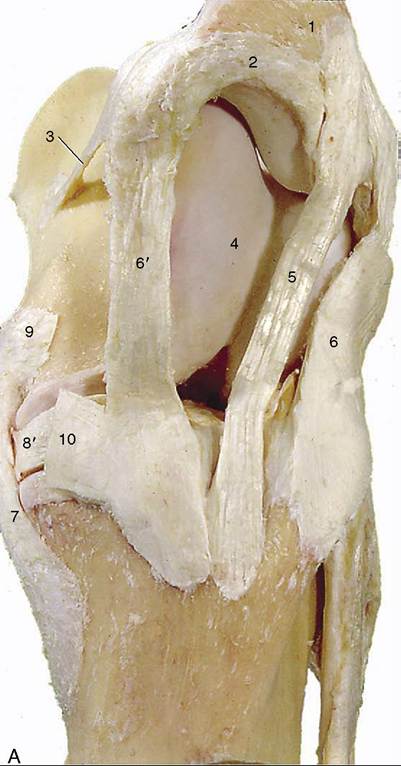
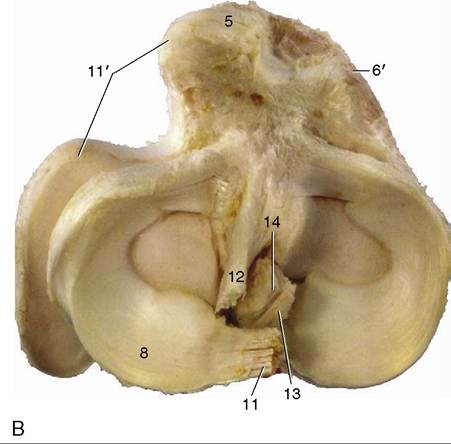
Figure 24-5 The ligaments of the left stifle joint. A, Medial view. B, Proximal view of the left tibia and the menisci. 1, Patella; 2, patellar flbrocartilage; 3, medial femoropatellar ligament; 4, medial ridge of trochlea; 5, intermediate patellar ligament; 6, 6', lateral and medial patellar ligaments; 7, 7’, lateral and medial collateral ligaments; 8, 8’, lateral and medial menisci; 9, insertion of semimembranosus; 10, insertion of gracilis and sartorius; 11, meniscofemoral ligament; 11', tendon of popliteus; 12, 13, cranial and caudal cruciate ligaments; 14, intercondylar eminence.
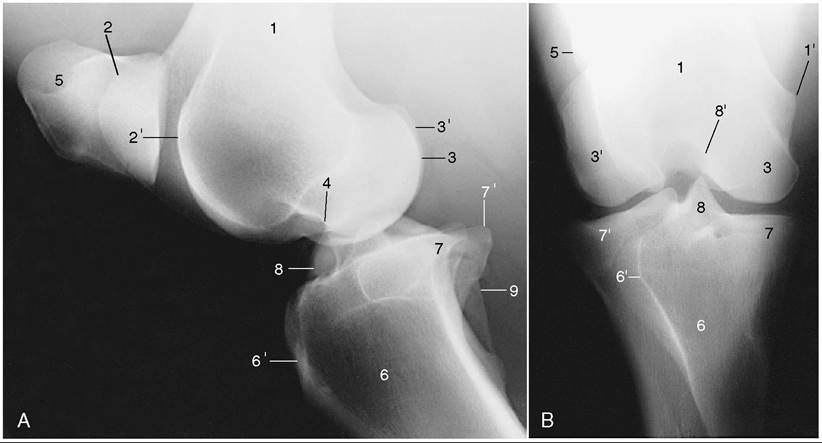
Figure 24-6 Lateral (A) and caudocranial (B) radiographs of the stifle joint. 1, Femur; 1', medial epicondyle; 2, 2’, medial and lateral ridges of the trochlea; 3, 3', medial and lateral condyles; 4, extensor fossa; 5, patella; 6, tibia; 6, tibial tuberosity; 7, 7’, medial and lateral condyles; 8, intercondylar eminence; 8’, intercondylar fossa; 9, fibula.
The patella slides up and down over the femoral trochlea during the greater part of the normal excursions of the joint. Only in extreme extension, as momentarily during the support phase of a walking stride, do the resting surfaces engage. The resting position is also adopted when the animal is standing squarely with its weight evenly distributed over the two hindlimbs. This is easily verified on palpation, and it can be found that the medial ligament then runs even with the edge of the corresponding ridge of the trochlea.
This position is maintained without the assistance of the main extensor (quadriceps femoris) of the stifle but does require some effort on the part of the muscles that converge on the medial and lateral patellar ligaments: the biceps and tensor fasciae latae laterally and the gracilis and sartorius medially. The position is unstable and the patella is easily dislodged; it then slips back onto the gliding surface of the trochlea.The joint cavity is capacious, and its division into compartments is relatively complete. The extensive fem- oropatellar compartment is mainly contained between the femur, the patella, and the quadriceps. The part distal to the patella is more accessible, though separated from the patellar ligaments (and retinaculum) by a thick cushion of fat. It communicates with the medial femo- rotibial compartment in the large majority of horses but with the corresponding lateral compartment in far fewer, perhaps 25%. The partition between the medial and lateral compartments is almost always imperforate. The inconstancy of these arrangements has considerable practical importance: it must be assumed that any infection spreads readily among the three compartments, while prudence dictates that therapeutic substances be separately injected into each.
Such injections require familiarity with the disposition of the ligaments and the ability to recognize them on palpation. The medial collateral ligament can be picked out close to its origin from the femoral epicondyle and provides a convenient landmark in puncture of the medial femorotibial compartment. The needle is introduced close to its cranial border, between it and the medial patellar ligament (Figures 24-4/7,77 and 24-5Zd',7'). The lateral collateral ligament is palpable along its whole length but is most easily found close to its insertion on the head of the fibula. The lateral femo- rotibial compartment is punctured between this ligament and the more cranial, and also palpable, tendon of origin of the long digital extensor (Figure 24-4Z77',76). The femoropatellar compartment is also easily entered from the side, behind the proximal part of the lateral patellar ligament (Figure 24-4/9). Alternatively, this compartment can be approached from in front, between the patellar ligaments, but this requires that the needle be passed through a considerable thickness of fat.