THE SWEAT GLANDS
Sweat glands are scattered over the entire body but are somewhat sparse in carnivores and pigs. Two types are distinguished by (a probably erroneous interpretation of) the histology of the secretory process.
Apocrine sweat glands discharge an albuminous sweat into hair follicles over most of the body. Eccrine glands secrete a more watery sweat directly onto certain naked, or nearly naked, regions of the skin (e.g., the nasolabial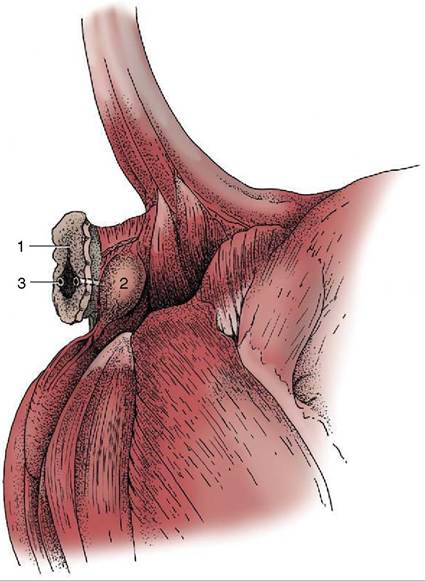
Figure 10-30 Exposed right anal sac of a dog. 1, Anus; 2, anal sac; 3, opening of excretory duct of anal sac (emphasized; see Figure 10—29, A/2).
plate of cattle and the footpads of dogs). The apocrine variety predominates, and its secretion and subsequent evaporation are important in salt metabolism and temperature regulation. The secretion is degraded by bacteria, which form substances that provide the characteristic body odor. The product of the eccrine variety is thought to play a lesser role in temperature regulation.
Most mammals possess fewer glands and sweat less profusely than humans. However, impressions can be misleading because the sweating that does occur tends to be masked by the more generous coat. The horse is an obvious exception to the general statement as it not only sweats abundantly but also produces an especially albuminous sweat that froths when worked by movement of the skin and coat (“lathering up”). Certain breeds of cattle also sweat visibly along the neck and over the flanks; in this species there are well-established differences in the number, size, and distribution of the glands between temperate and tropical breeds. Surprisingly, the Asiatic buffalo has fewer sweat glands than cattle and resorts to wallowing in water in compensation. Among domestic species, dogs and cats sweat least, although the skin of short-haired individuals sometimes feels moist. Sweat glands are present in the footpads of dogs and cats. In dogs, it is asserted that excessive activity of these glands may, in cold climates, lead to snow- or ice-balling on digital hair, making it painful for the animals to walk. Attention is apparently paid to this propensity when selecting sled dogs for breeding. It is not surprising to learn that Arctic wolves lack these glands.