The Vertebrate Retina Consists of Five Major CeIITypes
The retina is derived from Iteiiroectoderm9 a specialized portion of the ectoderm giving rise to the brain. For this reason, the retina is a fairly complex extension of the brain capable of considerable processing of the visual image before the information is transmitted toward the cerebral cortex.
The vertebrate retina consists of five major cell types: photoreceptor cells, bipolar cells, horizontal cells, amacrine cells, and ganglion cells (Figure 14-4). As in the cerebral and cerebellar cortices, the arrangement of these component cells is fairly consistent across the retina, suggesting a basic underlying processing mechanism and giving the retina a layered histology. However, local variations in the density of some cell types and in synaptic architecture account for particular functional variations within the retina.
There are two types of retinal photoreceptor cells: rods and cones (Figure 14-4). Both rods and cones make direct synaptic connection with the interneurons called bipolar cells, which connect the receptors with the ganglion cells. As previously noted, ganglion cell axons traverse the inner surface of the retina and converge at the optic disc to leave the eye and send action potentials to the brain through the optic nerves.
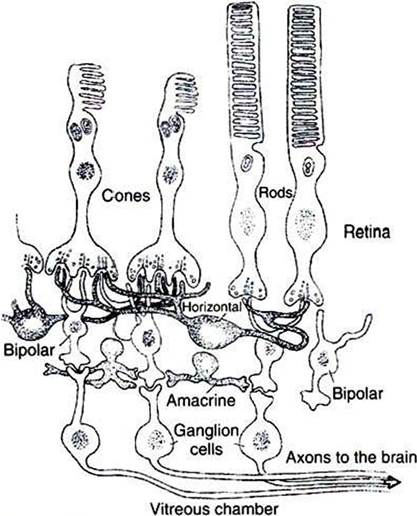
FIGURE 14-4 Vertebrate retina consists of five major cell types: photoreceptor cells (either rods or cones), bipolar cells, horizontal cells, amacrine cells, and ganglion cells. (Redrawn from Kandel ER, Schwartz JH: Principles of neural science, ed 2, NewYork, 1985, Elsevier Science Publishing.)
Modifying the flow of information at the synapses among the photoreceptors, bipolar cells» and ganglion cells are two interneuron cell types: the horizontal cells and the amacrine cells (Figure 14-4). The horizontal cells mediate lateral interactions among the photoreceptors and bipolar cells. The amacrine cells mediate lateral interactions among the bipolar cells and the ganglion cells.