Through the Process OfAccommodation, the Lens Changes Shape to Focus Images from Various Distances onto the Retina
When a camera focuses the images of objects at various distances from the film, the distance between the lens and the film is changed. The eye, however, focuses images by changing the shape of the lens, not by changing the distance between the lens and the retina.
Figure 14-3 shows the primary structures responsible for accommodation, the process by which the lens adds extra focusing power by changing its shape. The lens of the eye is
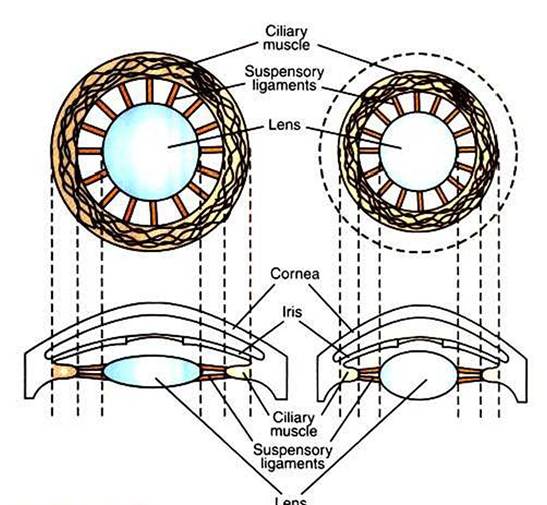
FIGURE 14-3 Primary ocular structures responsible for accommodation. The shape of the lens is shown when the ciliary muscle is relaxed (left) and contracted (right).
made up of an elastic lens capside containing a jellylike substance. If the eye’s lens were taken out of the eye, it would assume a spherical shape because of the elasticity of its capsule, much like a balloon filled with jelly. When suspended in the relaxed eye, however, the elasticity of the suspensory ligaments pulls on the equator of the lens, causing it to flatten in its anterior-posterior dimension. This flattened, less convex lens causes less refraction of light rays and allows the focus onto the retina of objects more than 20 feel away. To focus the image of objects closer to the eye, however, the lens must assume a more spherical, convex shape. This is accomplished by the contraction of the ciliary muscles of the ciliary body. This contraction of the ciliary muscle is much like the con- traction of a sphincter and decreases the inner diameter of the ciliary body. In turn, this moves the attachments of the suspensory ligaments to a new position closer to the lens and decreases the pull on the equator of the lens. The result, given the inherent elasticity of the lens capsule, is a more spherical lens with more light refraction that focuses onto the retina the image of nearer objects. The more the ciliary muscle contracts, the more spherical the lens becomes.
In humans, as the lens ages, it becomes less elastic and tends to become less spherical, even when the ciliary muscles contract. Many people older than 40 years of age need reading glasses to help their less elastic lens focus on objects nearby.
The lens should be clear and free of opacities. In cataracts, however, the lens becomes more opaque, causing random refraction of light and blurring vision, often leading eventually to blindness.