DEGENERATIVE CHANGES
The decline in organ function is very important in relation to aging, but the end result of aging, death, is related to this decline in only a very peripheral way if at all. In general, the cause of death of older domestic animals is degenerative diseases.
These comprise the various forms of cancer and cardiovascular diseases that can be characterized as arising primarily from within the body itself. For some people, some of the cells in the body do not function properly, and this may cause the entire machinery of the body to malfunction.25.4.1 Maximum Life Span and Life Expectancy
The maximum life span is a characteristic of the species. The maximum lifespan of a species is how long its longest observed member has lived. Life expectancy is the time at which approximately 50% of the members of a given population of a species still survive. It is the maximum number of years a member of that species has been known to survive. The maximum human lifespan is estimated to be 121 years (Arking, 1998). The life spans of tortoises and
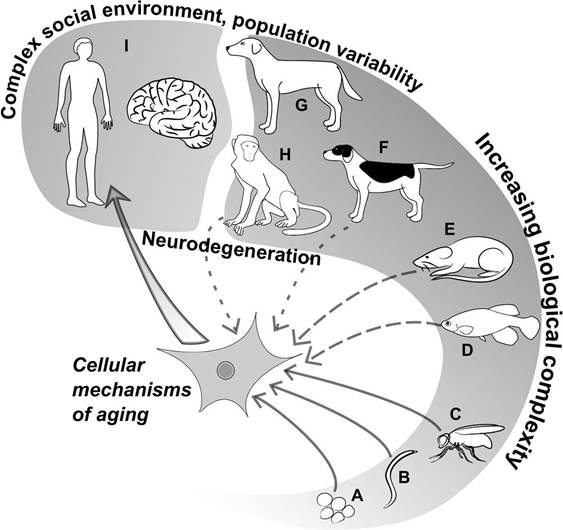
FIGURE 25.2 Model organisms of aging
lake trout are both unknown but are estimated to be more than 150 years. The maximum lifespan of a domestic dog is about 20 years, and that of a laboratory mouse is 4.5 years. Life expectancy, the amount of time a member of a species can expect to live, is not characteristic of species but of populations. It is usually defined as the age at which half the population still survives.
The phenomena of senescence and the diseases of aging are much more common today than they were a century ago. In 1900, people did not have the “luxury” of dying from heart attacks or cancers. These diseases generally occur in people over the age of 50. Rather, people died (as they are still dying in many parts of the world) from infectious diseases and parasites (Arking, 1998). Similarly, until recently, relatively few people exhibited the more general human senescent phenotype: graying hair, sagging and wrinkling skin, joint stiffness, osteoporosis (loss of bone calcium), loss of muscle fibers and muscular strength, memory loss, eyesight deterioration, and the slowing of sexual responsiveness. Life expectancy is the key metric for assessing population health. The ages of some wild animals can be determined by annual marks in scales or bones similar to treerings.
25.5
More on the topic DEGENERATIVE CHANGES:
- Compartment, Downer, and Muscle Crush Syndromes of Cattle
- EPIDEMIOLOGY
- Triaryl Phosphate Poisoning (Chronic Organophosphate Poisoning; Dying-Back Axonopathy)
- Peripheral Vestibular Disease of Horses
- Pregnancy Loss
- Temporohyoid Osteoarthropathy
- Vogelnest L., Portas T. (Eds.). Current Therapy in Medicine of Australian Mammals. CSIRO,2025. — 848 p., 2025
- Acquired Torticollis
- Smith Bradford P., Van Metre David C., Pusterla Nicola (eds.). Large Animal Internal Medicine. Part 2. 6th edition. — Elsevier,2020. — 2279 p., 2020
- Other Problems Affecting the Buck