mitochondria
Mitochondria is known as power house of cell. It is the second largest organelle in animal cells and is semiau- tonomous organelle. Mitochondria are present in immature RBC. It occur in all cells except RBC (Figure 2.2).
Mitochondria are membrane-bound cytoplasmic organelles responsible for energy production. The quantity of
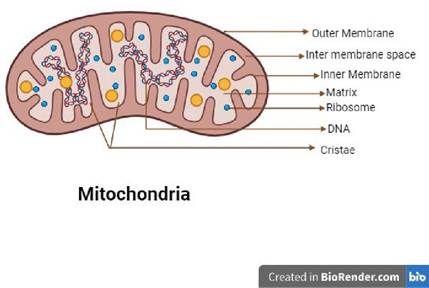
FIGURE 2.2 Mitochondria
mitochondria in each cell can vary based on the cell’s physiological functions. Additionally, there is a noticeable range of diversity in terms of shape and size. Typically, they are sausage-shaped or cylindrical, having a diameter of 0.2- 1.0μm (average 0.5μm) and length 1.0-4.1μm. Mitochondria are covered by double unit membrane. The outer membrane is smooth, permeable, and encloses the contents of the mitochondrion. The outer membrane of mitochondria contains various enzymes such as acetyl-CoA synthetase and glycerol phosphate acetyltransferase. The inner membrane projects into the central space in the form of fingerlike projections called cristae. ’’Cristae” is a name given by Palade. The cristae expand the surface area, creating a generous amount of space for metabolic activities. They are selectively permeable and contains all enzymes of the electron transport chain. Cristae contain various enzymes and other protein molecules which are involved in respiration and the synthesis of adenosine triphosphate (ATP). Elementary particles or oxysomes or F0-F1-particles are present on the inner membrane of mitochondria. They are differentiated into three parts: the base (round part of oxy- some), stalk (joins head with base), and head (embedded in the membrane). The headpiece (F1) behaves as an ATP synthase complex and thus synthesizes ATP by the virtue of proton gradient development. The inner compartment is filled with a dense homogeneous substance called the matrix. The matrix also possesses a single circular DNA molecule, a few RNA molecules, ribosomes (70S), and the components required for the synthesis of proteins.
2.10.1 Functions
• Mitochondria serves as the location for cellular respiration due to their possession of all necessary enzymes for the process.
• Energy (ATP) is produced within mitochondria as they are the site of cellular respiration.
• Mitochondria play a role in yolk formation during ovum development (vitellogenesis).
• Mitochondria in the formation of the middle piece of sperm during sperm maturation. Additionally, mitochondria aid in the elongation of fatty acids and are involved in cytoplasmic inheritance.
2.11
More on the topic mitochondria:
- Drugs and Toxins With Effect on Body Temperature
- Exercise Intolerance and Poor Performance in Horses
- Classification of Muscle Disorders
- Phylogenetic Position of Zoophilic Dermatophytes and Their Identification
- Complications Associated With Parenteral Nutrition
- Sorghum Toxicity
- Treatment
- Nutritional Myodegeneration
- Inherited and Congenital Diseases
- Transmissible Fungal Infections