The Immediate Cardiovascular Effects of Hemorrhage Are Minimized by Compensations Initiated by the Atrial Volume Receptor Reflex and the Arterial Baroreceptor Reflex
Figures 26-4 and 26-5 summarize the cardiovascular responses to hemorrhage. The curve labeled Normal in Figure 26-4 shows that the maintenance of a normal stroke volume depends on the maintenance of a normal level of ventricular preload.
WTien hemorrhage occurs, blood is lost from the whole cardiovascular system, particularly from the veins, which are the blood reservoirs of the body. Hemorrhage therefore decreases central venous volume, central venous pressure, and atrial pressure. The decrease in atrial pressure decreases ventricular preload and end-diastolic ventricular volume. In the absence of any compensation, the stroke volume decreases from point / in Figure 26-4 to point 2. Note that the normal ventricular function curve is rather steep to the left of the normal operating point (point 1). Therefore a 40% hemorrhage results in approximately 40% reductions in central venous pressure, left atrial pressure, ventricular preload, and stroke volume. In the absence of compensations, cardiac output and mean arterial pressure (MAP) would also decrease by 40%. MAP would then be inadequate to sustain normal function in the critical organs, and the animal would die. With intact compensatory mechanisms, however, a normal animal can withstand a 40% hemorrhage without death and have only about a 10% decrease in MAP.The immediate compensations for hemorrhage are initiated by the arterial baroreflex and atrial volume receptor reflex. Hemorrhage decreases MAP, which decreases the activity of arterial baroreceptors. The baroreflex response is to increase sympathetic activity and to decrease parasympathetic activity. The increased sympathetic activity acts on the heart to increase cardiac contractility. This helps restore stroke volume back toward normal, despite a persistent, subnormal preload and end-diastolic volume. The effect of this sympathetic compensation is diagrammed in Figure 26-4 as point 3.
Although stroke volume is returned toward normal, it remains low; after compensation for a 40% hemorrhage, the stroke volume may remain 25% below normal.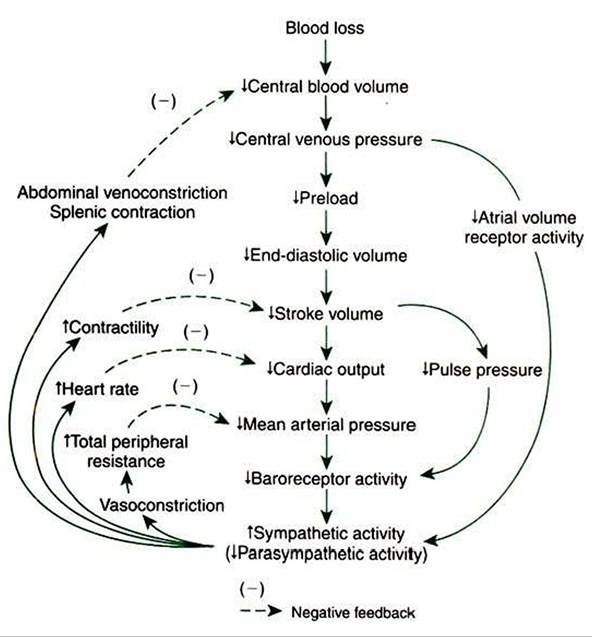
FIGURE 26-5 Summary of the consequences of hemorrhage and the rapid compensations from the arterial baroreflex and atrial volume receptor reflex.The changes described here include those presented in Figure 26-4.
Additional compensations help restore blood pressure closer to normal despite the persistence of low stroke volume. First, heart rate increases above normal, which brings cardiac output back to within about 20% of its normal level. In addition, sympathetic vasoconstriction in the noncritical organs raises TPR above normal, resulting in a MAP that remains within approximately 10% of its normal level, despite a persistent 20% drop in cardiac output. The reader can review the compensations described thus far by locating them on Figure 26-5.
You may wonder why baroreflex compensatory actions continue if MAP is returned most of the way toward normal. Compensatory baroreflex responses are sustained because baroreceptors are responsive to changes in pulse pressure as well as to changes in MAP, and pulse pressure remains low. There are two reasons for the subnormal pulse pressure: (1) the persistent decrease in stroke volume and (2) the increase in heart rate above normal. Thus, even if MAP is returned substantially toward normal after compensation for a hemorrhage, baroreceptor activity (action potential frequency) remains below normal.
The atrial volume receptor reflex also contributes to the sustained increase in sympathetic activity after hemorrhage. As shown in Figure 26-5, hemorrhage leads to a persistent decrease in central venous pressure and atrial pressure. Therefore the activity of the atrial volume receptors is decreased below normal. The CNS responds to this decreased afferent activity from atrial volume receptors by elevating sympathetic efferent activity and by decreasing cardiac parasympathetic efferent activity.
Thus the atrial volume receptor reflex and the arterial baroreflex work synergistically to compensate for hemorrhage.In severe hemorrhage the reflex increases in sympathetic activity affect not only the heart and resistance vessels but also the veins. The abdominal veins in particular are constricted when sympathetic activation is intense. Sympathetic veno- Constriction displaces blood from the abdominal veins and moves it toward the central circulation, which helps to increase central venous pressure, atrial pressure, and preload back toward normal (Figure 26-5). Sympathetic activation also constricts the blood vessels within the spleen and the muscular capsule around the spleen. The blood that is sequestered in the spleen is expelled into the abdominal veins, and then it moves toward the heart. In species that have large spleens (e.g., dog and horse), splenic contraction can mobilize a volume of blood equal to 10% of the total blood volume. An additional, adaptive feature of the blood sequestered in the spleen is that it has a higher-than-normal hematocrit. The mobilization of these sequestered red blood cells helps to offset the fall in hematocrit that is a normal consequence of interstitial fluid reabsorption after hemorrhage (as described next).
The arterial baroreceptor reflex and the atrial volume receptor reflex act within a few seconds to restore blood pressure toward its normal level after a hemorrhage. Other
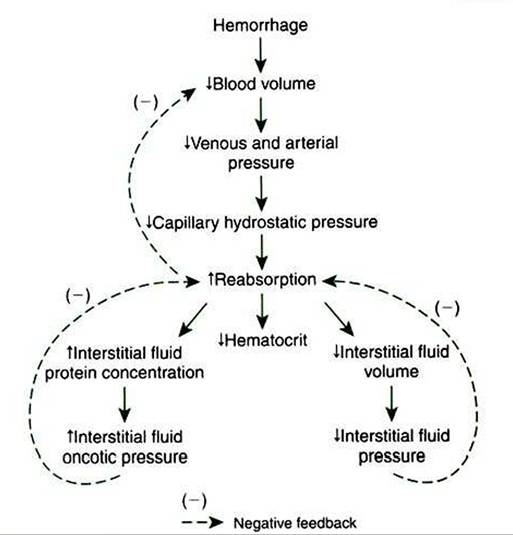
FIGURE 26-6 During the first 3 to 4 hours after a hemorrhage, interstitial fluid is reabsorbed into the bloodstream, which helps compensate for the lost blood volume. A complication is that the hematocrit decreases. Reabsorption is limited by decreases in interstitial fluid hydrostatic pressure and by increases in interstitial fluid oncotic pressure.
compensations come into play in the minutes and hours after hemorrhage to restore the lost fluid volume.
More on the topic The Immediate Cardiovascular Effects of Hemorrhage Are Minimized by Compensations Initiated by the Atrial Volume Receptor Reflex and the Arterial Baroreceptor Reflex:
- The Immediate Cardiovascular Effects of Hemorrhage Are Minimized by Compensations Initiated by the Atrial Volume Receptor Reflex and the Arterial Baroreceptor Reflex
- KEY POINTS