» The Liver
The liver is quite variable in form and size but on average weighs about 5 kg in a saddle horse. At about 1.5% of the body weight, it is a much smaller proportion than in carnivores.
It is situated in the most cranial part of the abdomen directly against the diaphragm. It is markedly asymmetrical in the healthy young subject, in which about two-thirds lies to the right of the median plane (see Fig. 21.7/2). The most caudal part, which is also the most dorsal, lies ventral to the vertebral extremities of the 16th and 17th ribs of the right side; the most cranial and most ventral part lies against the left part of the vertex of the diaphragm (Fig. 21.6/3). The long axis thus runs obliquely. In the newborn foal the liver is more symmetrical and relatively much larger and extends onto the abdominal floor behind the costal arch. In older subjects atrophy of the liver is common and is most obvious in the right lobe, probably resulting from chronic pressure from the right dorsal colon and cecal base. Less often, the left lobe atrophies, perhaps under pressure from the stomach.
The parietal surface is joined to the diaphragm by a complicated system of ligaments. The visceral surface lies against and is impressed by the stomach, duodenum, dorsal diaphragmatic flexure of the colon, and cecal base (see Fig. 21.10). The porta is central, within an area made rough by the direct attachment of the pancreas. The dorsal fixed margin of the liver extends between the right and left triangular ligaments and is very irregular (Fig. 21.21). Its right part is thick and excavated to receive the cranial pole of the right kidney; a sulcus medial to this transmits the caudal vena cava. Its left part is much thinner and does not extend nearly so far dorsally. It carries the impression of the esophagus close to the midline. The long free margin is much sharper and is interrupted by a series of fissures, the largest of which divide named lobes. The current nomenclature recognizes left, quadrate, right, and caudate lobes. The first two are separated by the fissure carrying the round ligament of the liver (vestige of the umbilical vein), but the boundaries of the others are more arbitrary and are of doubtful morphologic significance.
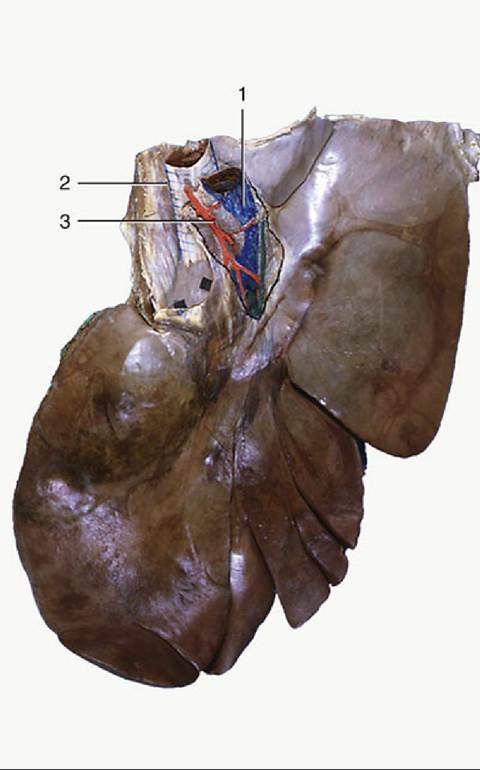
FIG. 21.21 Visceral surface of the liver. 1, Portal vein; 2, caudal vena cava; 3, hepatic artery.
The duct system is remarkable for the absence of a gallbladder, but its wide caliber compensates for this. The bile duct opens into the cranial duodenum on the papilla shared with the major pancreatic duct (see Fig. 21.9/7). The oblique passage of the duct through the duodenal wall serves as a sphincter and prevents the influx of ingesta.
More on the topic » The Liver:
- Bacterial Diseases
- INFECTIOUS DISEASE
- Diseases of the biliary tract
- Smith Bradford P., Van Metre David C., Pusterla Nicola (eds.). Large Animal Internal Medicine. Part 2. 6th edition. — Elsevier,2020. — 2279 p., 2020
- Nutritional Diseases
- Smith Mary C., Sherman David M.. Goat Medicine. 3rd edition. — Wiley-Blackwell,2023. — 976 p., 2023
- Environmental Insults
- Swellings Involving the Head
- Other Problems Affecting the Buck
- Interdigital Necrobacillosis (Foot Rot) in Cattle