Urethral Hemorrhage
Harold C. Schott II • Alexandra J. Burton
Although a recognized cause of hemospermia in stallions, defects or tears of the proximal urethra at the level of the ischial arch are a more recently described cause of hematuria in geldings.1-4 Urethral defects typically result in hematuria at the end of urination, in association with urethral contraction.
Affected horses generally void a normal volume of urine that is not discolored. At the end of urination, a series of urethral contractions results in squirts of bright red blood. Occasionally, a smaller amount of darker blood may be passed at the start of urination. In most cases, the condition does not appear painful or result in pollakiuria. Interestingly, the majority of affected stallions with hemospermia and geldings with hematuria have been Quarter Horses or Quarter Horse crosses that have been free of other complaints. Treatment with antibiotics for a suspected cystitis or urethritis has been routinely unsuccessful, although hematuria appears to resolve spontaneously in about 50% of affected horses. Because the defects are difficult to detect without use of high-resolution videoendoscopic equipment, previous reports of urethral bleeding have been attributed to urethritis or hemorrhage from “varicosities” of the urethral vasculature. However, vasculature underlying the urethral mucosa becomes quite prominent when the urethra is distended with air during endoscopic examination, especially in the proximal urethra (to the point that blood can be seen flowing in the submucosal vasculature). Thus, it would be logical to suspect that hemorrhage could arise from an apparent urethritis or urethral varicosity, although these problems are poorly documented in horses.Examination of affected horses is often unremarkable, and laboratory analysis of blood reveals normal renal function, although mild anemia can be an occasional finding.
Urine samples collected midstream or by bladder catheterization appear grossly normal. Urinalysis may have normal results, or an increased number of red blood cells may be found on sediment examination, a finding that would also result in a positive reagent strip result for blood. Bacterial culture of urine yields negative results. The diagnosis is made with endoscopic examination of the urethra, during which a lesion is typically seen along the dorsocaudal aspect of the urethra at the level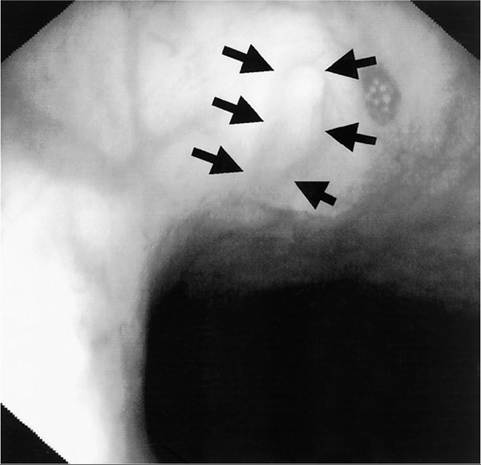
FIG. 34.14 Endoscopic image of the proximal urethra of a gelding with hematuria at the end of urination. A urethral defect can be seen between the arrows along the caudal aspect of the urethra as it passes dorsocranially over the pelvic brim.
of the ischial arch. External palpation of the urethra in this area is usually unremarkable but can assist in localizing the lesion, because external digital palpation can be seen through the endoscope. With hematuria of several weeks' duration, there is little evidence of inflammation; rather, the lesion appears as a fistula communicating with the vasculature of the corpus spongiosum penis (Fig. 34.14).
Although the pathophysiology of this condition remains unclear, it has been speculated that the defect is the result of a “blowout” of the corpus spongiosum penis (cavernous vascular tissue surrounding the urethra) into the urethral lumen.3 Contraction of the bulbospongiosus muscle during ejaculation causes a dramatic increase in pressure in the corpus spongiosum penis, which is essentially a closed vascular space during ejaculation. The bulbospongiosus muscle also undergoes a series of contractions to empty the urethra of urine at the end of urination, so the defect into the urethra may develop by a similar mechanism in geldings. Once the lesion has been created, it is maintained by bleeding at the end of each urination, and the surrounding mucosa heals by formation of a fistula into the vascular tissue.
An explanation for the consistent location along the dorsocaudal aspect of the urethra at the level of the ischial arch has not been documented but may be related to the anatomy of the musculature supporting the base of the penis and an enlargement of the corpus spongiosum penis in this area. Narrowing of the lumen at the distal extent of the ampullar portion of the urethra may also contribute to the location of the defects. An anatomic predisposition in Quarter Horses has not been documented but could be speculated on the basis of an apparent increased risk in this breed.Because hematuria may resolve spontaneously, no treatment may be initially required. Resting of breeding stallions for several months may facilitate healing of the rent and cessation of recurrent bleeding. If hematuria persists for more than a month or if significant anemia develops, surgical intervention is indicated. Surgical approaches are aimed at reducing decreasing pressure within the corpus spongiosum, with the goal of reducing tension on the urethral rent site and thus allowing it to heal.3 A temporary subischial “incomplete” urethrotomy has been successful in some affected geldings. After sedation and epidural or local anesthesia, a catheter is placed in the urethra and a vertical incision is made into the corpus spongiosum penis but not the urethral lumen. The surgical wound requires several weeks to heal, and moderate hemorrhage from the corpus spongiosum penis is apparent for the first few days after surgery. Hematuria should resolve within a week after this procedure. Additional treatment consists of local wound care and prophylactic antibiotic treatment (typically a trimethoprim-sulfonamide combination) for 7 to 10 days. Most recently, a case series (1989 to 2013) of 33 male horses (stallions and geldings) with urethral rents treated with perineal urethrotomy (PU) or corpus spongiotomy (CS) has been described.4 Both PU and CS were successful in the long term for resolving hematuria in horses with urethral rents but did not always resolve hemospermia in stallions.4 Repair of a urethral defect using subischial urethrotomy and a buccal mucosal urethroplasty has been described as a successful treatment for recurrent hemospermia in one stallion.5
More on the topic Urethral Hemorrhage:
- Urethral Hemorrhage
- Male Reproductive Disorders
- Hematuria and Pigmenturia
- Enzootic Hematuria
- Urinary Tract Infection
- Smith Bradford P., Van Metre David C., Pusterla Nicola (eds.). Large Animal Internal Medicine. Part 2. 6th edition. — Elsevier,2020. — 2279 p., 2020
- Serum Protein
- Dysuria, Stranguria, and Incontinence
- Physical Examination
- Equine Herpesvirus Myeloencephalopathy