Copper Deficiency in Ruminants
John Maas • Bradford P. Smith
Definition and Etiology
Copper deficiency occurs when the diet contains an abnormally low amount of copper (primary copper deficiency) or when copper absorption or metabolism is adversely affected (secondary copper deficiency).
If inadequate amounts of copper are available to tissues in the form of essential metalloenzymes, the signs of copper deficiency (hypocuprosis) may occur. Clinical signs in ruminants can include diarrhea, decreased weight gain, unthrifty appearance, anemia, changes in coat color (achro- motrichia) or wool quality, anemia, spontaneous fractures, lameness (epiphysitis), and demyelinization (enzootic ataxia of sheep and goats, or swayback). One of these syndromes usually predominates in a given herd. The reason or reasons that one or another syndrome predominates are unknown. For example, a report from New Zealand concluded that protein-calorie malnutrition with periods of copper deficiency resulted in spontaneous fractures in dairy heifers.1The minimum recommended dietary copper concentration (dry matter basis) is 4 to 10 ppm (mg/kg) for cattle,2,3 5 ppm for sheep,4 and 7 ppm for merino sheep.4 Young animals and fetuses are more susceptible to copper deficiency than are mature animals, and cattle are more susceptible than are sheep. Secondary copper deficiency is associated with high dietary levels of molybdenum, sulfates, zinc, iron, or other compounds. Secondary copper deficiency often presents with clinical signs of diarrhea and weight loss or unthriftiness. It has been called teart, peat scours, renguerra, pine, and salt lick disease.5 Salt sickness in Florida appears to be the result of combined copper and Co deficiencies. The cause of copper deficiency in clinical cases is often multifactorial and can be difficult to quantify.
In addition, unknown factors cause clinical expression of copper deficiency in ruminants to be manifested as a variety of syndromes.Clinical Syndromes and Differential Diagnosis
Profuse watery diarrhea with poor weight gains or weight loss is a common syndrome seen in ruminants with copper defi- ciency.5 When it occurs on boggy pastures that contain high concentrations of molybdenum, it has been referred to as teart5 Decreased weight gains or weight loss as a herd problem can have many other causes, including parasitism, trace mineral deficiencies (selenium, cobalt), protein calorie malnutrition, and Johne's disease. A syndrome characterized by epiphyseal enlargement, stiffness, and unthriftiness is seen in young ruminants and is the result of copper deficiency6 and is sometimes called pine.5 Copper deficiency can cause spontaneous fractures in ruminants and can be associated with phosphorus deficiency or protein-calorie malnutrition.1 Enzootic neonatal ataxia (swayback) of lambs and kids is characterized by progressive incoordination and recumbency that begins with the hind limbs and progresses to the front-limbs. It has also been reported in deer and pigs. Inadequate keratinization of wool and achromotrichia is the result of imperfect oxidation of free thiol groups during hair growth and keratinization. Subsequently, the wool fibers do not crimp normally, and they appear to be “stringy” or “kinky.” A copper-containing enzyme, tyrosinase (polyphenol oxidase), is needed to convert L-tyrosine to melanin. With copper deficiency, this conversion is slow and hair is lighter in color than normal (achromotrichia). Loss of wool crimp and pigmentation changes in sheep or cattle, respectively, occur late in the course of copper deficiency. In addition to the previously listed clinical syndromes that may occur alone or jointly, copper deficiency may be associated with anemia7 (altered iron metabolism) or infertility.8 Infertility probably has multifactorial causes and may not respond to an increase in copper intake alone.
Copper deficiency also seems to result in decreased immune function in ruminants.9,10Pathogenesis
A frank dietary deficiency of copper results in hypocuprosis and eventual clinical signs. Also, a variety of conditions can decrease copper absorption from the gastrointestinal tract (large intestine in sheep and small intestine in cattle). The interactions between dietary copper, molybdenum, and sulfates (or sulfur) are important (Fig. 32.142). Excess dietary molybdenum can lead to the formation of sparingly soluble cupric molybdates in the rumen that are not absorbed from the intestine. The addition of excess sulfur or sulfates in the diet or water can result in the formation of insoluble copper thiomolybdates in the rumen. The interactions among these three elements are complex.11 The infertility seen with secondary copper deficiency may be caused by excess circulating oxythiomolybdates, which interfere with the release of luteinizing hormone.12 However, the feeding of dried distillers grain, with a high sulfur content, at 0.75% body weight as fed did not result in differences in average daily gain, body weight, plasma copper, or plasma zinc concentrations in comparison to control cattle.13 This study concluded that high sulfur, dried distillers grain fed at 0.75% body weight did not result in copper antagonism; however, liver copper concentrations were not measured.13
Of importance is that at low sulfur concentrations in the diet, excess molybdenum has a minimum effect on decreasing copper absorption. Even when no dietary molybdenum or sulfates are present, only approximately 5% of ingested copper is ordinarily absorbed. Excessive calcium in the diet, particularly
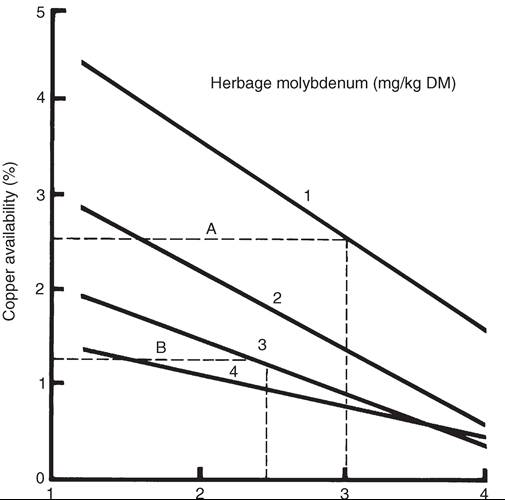
lead to secondary copper deficiency,
Sulfur in herbage (g/kg DM)
FIG. 32.142 Estimating the availability of copper in herbage from its molybdenum and sulfur concentrations: the difference of 3 mg of molybdenum and 0.5 g of sulfur per kilogram of dry matter (DM) between two pastures (A and B) is sufficient to reduce availability from 2.6% to 1.3%, thereby doubling a grazing animal’s requirement of copper from the pasture.
(From Suttle NF. 1986. Copper deficiency in ruminants: recent developments. Vet Rec 119:519.)in the form of limestone, decreases copper absorption. Excessive iron, 30 mg/kg of body weight or 1200 ppm in the diet of calves, reduces copper absorption.14 Overgrazing, with the subsequent ingestion of excess soil, also decreases copper absorption. In addition, excess cadmium (3 to 7 ppm) or excess zinc (100 to 400 ppm) reduces hepatic copper concentration, probably through the combined effects of decreased absorption and competition with copper for hepatic metallothionein.15,16 It had been suggested that excess dietary selenium might interfere with copper absorption, utilization, or both, but this has been shown not to occur.17 Copper is an essential component of a number of mammalian enzymes. Some of the medically important copper-containing enzymes are (1) the cytosol form of superoxide dismutase (copper and zinc), (2) cytochrome oxidase (c and aa3), (3) lysyl oxidase, (4) ascorbic acid oxidase, and (5) ceruloplasmin.18 In addition, normal copper nutrition appears essential for iron absorption and transportation of iron to the liver and reticuloendothelial system and is thus necessary for normal hemoglobin formation. The precise pathophysiologic mechanism of most of the copper deficiency syndromes is not known. However, the central role of copper in preventing cellular oxidative damage and its role in iron and sulfur metabolism are probably important.
Epidemiology
Copper deficiency can occur when diets are inadequate in copper or contain excess amounts of interfering substances, particularly molybdenum and sulfates. This occurs in many parts of North America. Forages and water can be sources of molybdenum, sulfur, and sulfate. To avoid primary copper deficiency, pasture (dry matter) should contain over 5 ppm of copper, with 3 to 5 ppm considered marginal and less than 3 ppm deficient. Soil copper concentrations are generally slightly lower than those of the harvested forage.
Molybdenum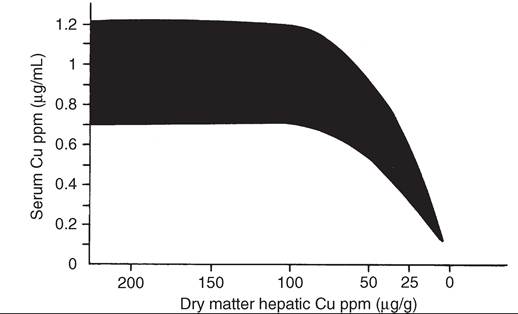
FIG. 32.143 Relationship between serum and hepatic copper concentration in ruminants.
adversely affects plant uptake of copper. Forage molybdenum concentrations greater than the copper concentrations often even when forage copper is adequate. Because copper content in grasses and legumes can be different, forage samples must be selected to reflect dietary intake. Forage copper concentrations as high as 12 to 27 ppm have been associated with copper deficiency when molybdenum levels are high.5 The critical ratio of copper to molybdenum in feeds is 2 : 1, with 5 : 1 recommended for sheep and 5 : 1 to 10 : 1 for grazing cattle.
Clinical Pathology and Diagnosis
The primary site of copper reserves is the liver and the copper concentration in the hepatic tissue is the best indicator of copper status (Fig. 32.143). The reference range for hepatic copper concentrations in cattle is approximately 90 to 200 μg∕g (ppm) and in sheep 90 to 250 μg∕g on a dry weight basis (dry matter basis [DMB]).5,19,20 Hepatic copper concentrations as high as 250 μg∕g DMB are not unusual in supplemented ruminants (even over 350 μg∕g DMB in sheep). Blood (serum or plasma) copper concentrations can be maintained near normal until hepatic copper concentration falls to 35 ppm DMB or less, at which time the serum copper concentration invariably begins to decrease.21 When blood samples are used for copper level determination, serum or plasma are normally preferred. Plasma copper concentration is usually approximately 5% greater than an identical serum copper concentration.22 Normal serum copper is 0.7 to 1.2 ppm (μg∕mL).5,18 Serum or plasma copper concentrations of 0.4 ppm or less are considered as evidence of frank deficiency. Values of 0.4 to 0.7 ppm are marginal and it is difficult to estimate the actual liver copper concentration on the basis of these serum copper concentration ranges.
Approximately 50% to 90% of the copper in serum or plasma is present in ceruloplasmin. The remainder is bound to albumin or amino acids. The correlation between serum copper and serum ceruloplasmin was found to be weak (0.50)22; thus ceruloplasmin is not commonly used to aid in diagnosing copper deficiency. In addition, serum ceruloplasmin increases with inflammatory conditions and can result in falsely higher values. Hepatic copper concentration is the preferred diagnostic sample and is easily secured at necropsy. Hepatic copper values less than 35 ppm DMB are considered deficient.5,19-21 However, surgical biopsy is necessary for live patients, and, because laboratories generally require 100 mg or more of tissue, a biopsy instrument with an internal diameter of 3 to 5 mm is necessary.23 The biopsy procedure in cattle is performed by locating the tenth intercostal space on the right side of the animal along a line from the tuber coxae (point of the hip) to the point of the shoulder.23 This site is surgically prepared and blocked with lidocaine (12 mL of 2% lidocaine) and a stab incision is made. The biopsy instrument is directed slightly ventrad and craniad and advanced through the intercostal space and the diaphragm to enter the liver where the biopsy sample is obtained.23 The liver biopsy can place the patient at increased risk for black disease or bacillary hemoglobinuria in some areas. This risk should be decreased by prior vaccination and a single dose of procaine penicillin G (4 million IU SC) administered at the time of biopsy. This technique has been shown to be safe and effective.23 The tissues of young animals (neonates) contain variable amounts of copper compared with adults of the same species. In sheep, serum and liver copper concentrations are the same for lambs (1 week of age) and adults.24 The plasma copper levels in lambs are low at birth but rise to adult values by 1 to 7 days of age. Plasma copper levels in the bovine neonate are lower than in mature cattle.25 In the bovine neonate hepatic copper concentration changes little from birth to maturity; however, copper distribution in the liver is quite variable in neonates.20,25 Because of these differences, interpretation of neonatal serum copper concentrations is difficult. Milk is a poor source of copper, containing only 0.2 to 0.6 ppm in normal ewes and 0.01 to 0.02 ppm in severely copper-deficient ewes or cows. Milk copper concentration in cattle is 0.05 to 0.2 ppm. To make matters worse, molybdenum is concentrated in milk.26 Research has allowed for the estimation of true wet weight (fresh) or dry weight of hepatic samples by concurrently measuring potassium in the specimen.27 This allows for much more accurate estimation of hepatic copper concentration in samples that have become dehydrated before reaching the diagnostic laboratory. This technique allows the laboratory to accurately estimate the original wet weight or to calculate the dry weight without time-consuming drying of the specimen.27Treatment and Control
Treatment of copper-deficient animals is usually possible, and the prognosis is guarded to good, depending on the severity of the deficiency and the associated syndrome or syndromes. When excess molybdenum, sulfate, and other factors leading to secondary deficiency are present, they can be overcome to some extent by increasing dietary copper or by injecting copper glycinate. Copper glycinate must be prescribed by the attending veterinarian and dispensed by a compounding pharmacy as no commercial over-the-counter products are currently available. There are currently very few compounding pharmacies manufacturing injectable copper glycinate. Injectable copper glycinate (30% copper by weight) is given to adult cattle at the rate of 400 mg (120 mg copper) subcutaneously. Calves are given 100 to 200 mg of copper glycinate (30 to 60 mg of copper), depending on their age. One injection may be effective as a treatment/ supplement for up to 4 to 6 months in cases of primary copper deficiency. However, in cases of excess molybdenum, sulfates, or sulfur, repeat injections may be necessary. Injections of copper glycinate frequently result in large swellings, granulomas, or abscesses and may be cosmetic considerations for some cattle. These reactions can be minimized with sterile technique and the use of the subcutaneous tissue of the brisket as the injection site. Acute deaths can occur in calves after the use of copper glycinate injections. In some countries copper disodium edetate solutions are used as injectable copper supplements. The dosage of copper is usually the same as that recommended for copper glycinate solutions. Also, acute deaths can occur after copper disodium edetate use in cattle.28 Copper can be supplemented to cattle in salt-mineral mixes in situations in which adequate consumption (1 to 2 oz [28 to 56 g]/cow/ day) of the salt-mineral mix occurs. These mixes are usually 0.2 to 0.6% copper. Feed grade copper sulfate (CuSO4-5 H2O) is 25% copper on an as-fed basis (40% copper on dry matter basis). Feed-grade copper oxide is usually 50% copper as fed (80% copper on a 100% dry matter basis). To make a 0.4% copper salt mixture, 7.2 g of CuSO4 or 3.6 g of CuO is added to each 454 g (1 pound) of salt. For large batches, 14.52 Kg (32 pounds) of CuSO4 or 7.26 Kg (16 pounds) of CuO is added to each ton of salt. Salt mixtures for copper-deficient sheep should usually contain only 0.0625% to 0.13% copper (0.25% to 0.5% copper sulfate). Copper supplements can be added to a total mixed ration easily in the form of trace mineral-vitamin premixes or premix-containing pellets. Copper sulfate can be added to molasses or other sweet feed at 0.363 g/head/day for mature cattle and correspondingly less for calves. This would supply approximately 91 mg of copper to a 450-kg (1000-pound) cow per day or 10 ppm of the total diet (20 pounds [9.1 kg] of dry matter). The copper in CuSO4 is more available than that in CuO.
Another method of copper supplementation involves the oral administration of copper oxide needles (fine rods, 1 to 10 mm long) placed in gelatin capsules that dissolve in the reticulorumen and liberate the CuO wires. These wires reside in the reticulum and abomasum and slowly release copper for absorption. These boluses are currently available in the United States (Copasure, Animax, Bury St. Edmunds, Suffolk, U.K.]) and contain either 25 g or 12.5 g per bolus. The usual recommended dosage is 25 g per animal weighing 227 kg (500 pounds) or more. One 12.5-g bolus is recommended for calves and the usual dose is 2 to 4 g for ewes and does,5,29,30 which is an extra label recommendation for sheep and goats. The copper oxide needles are thought to provide copper supplementation for 4 to 12 months. A rumen bolus containing a number of trace minerals (copper, iodine, manganese, selenium, zinc, and cobalt) has been made available in the United States (Reloader 250, Cargill, Minneapolis, Minn.). This bolus contains 6.0% copper and would release an average of 46 mg copper per day over a 250-day period. This would be a biologically significant percentage of the daily 40-100 mg of copper requirement for adult cattle. The report31 of its efficacy detailed the measurement of plasma copper and found no differences between affected cattle and control animals; however, liver copper concentrations would have been the preferred measurement for copper status. Perhaps future studies will detail the practical pharmacodynamics of this device with regard to copper and other trace minerals. Sheep are particularly susceptible to copper toxicity, and appropriate care is necessary when supplementing them. Sheep can easily be intoxicated when consuming cattle supplements or feeds. Continued monitoring of hepatic copper concentration from slaughtered animals or via liver biopsy is an important tool in evaluating copper supplementation methods in cattle and sheep. Lambs can be given 35 mg of copper sulfate per head twice weekly to prevent swayback in endemic areas.
The usual recommendation by the National Research Council (NRC) is 10 ppm (10 mg/kg) of the total diet on a dry matter basis for cattle. However, diets of 20 ppm are commonly fed to lactating dairy cattle. The 2001 NRC recommendations for dairy cattle state that 40 mg/kg (ppm) of the diet on a dry matter basis is the maximum tolerable level, unless significant interference by molybdenum, sulfur, or other antagonists are present.32 This is due to a number of copper toxicity episodes in the United States when the total diet contained 40 to 50 mg/kg copper or more in the total ration. In addition, the European Food Safety Authority (EFSA) has decreased the maximum concentration of copper in complete feeds to 15 ppm for pre-ruminant calves, 30 ppm for cattle, 15 ppm for sheep, and 35 ppm for goats.33 Copper has the smallest margin of safety of all the trace minerals in ruminants. The most important goal of copper supplementation is to provide adequate dietary amounts without over-supplementing or risking toxicity.
More on the topic Copper Deficiency in Ruminants:
- Copper Deficiency in Ruminants
- Spontaneous Fractures in Ruminants
- Amyloidosis
- Smith Bradford P., Van Metre David C., Pusterla Nicola (eds.). Large Animal Internal Medicine. Part 2. 6th edition. — Elsevier,2020. — 2279 p., 2020
- Postparturient Hemoglobinuria
- Abnormal Pigmentation
- Mechanisms of Decreased Growth and Decreased Weight Gain
- Diarrhea
- Approach to the Diagnosis and Management of Decreased Growth and Decreased Weight Gain in Ruminants
- Trace Minerals