Pathogenicity
Once inhaled, the fungus may be destroyed in the lung parenchyma by non-specific phagocytic cells, or it may multiply and produce a primary focus that drains into the regional lymph node located in the pulmonary hilum, compounding the primary complex in PCM.
The fungus may spread via the lympho-hematogenic route and develop metastatic foci in any organ or host tissue. At this time, the infection is asymptomatic or oligosymptomatic and can develop into one of the following conditions: (1) complete resolution and healing, (2) involution maintenance of viable fungi in quiescent foci, or (3) progression to pulmonary and/or disseminated progressive disease (Franco et al. 1993; Montenegro and Franco 1994).In host tissue an inflammatory response culminates in granuloma formation. The granuloma is composed of multinucleated giant cells and epithelioid cells, and its center contains one or more yeast cells in contact with polymorphonuclear
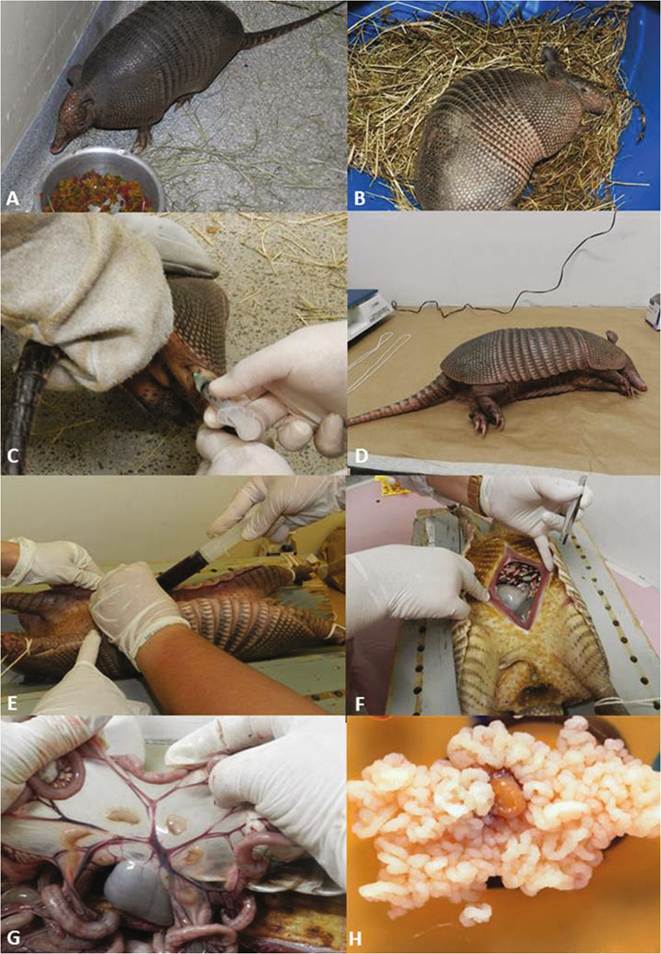
Fig. 6.3 Overview of armadillo’s handling procedure for P. brasiliensis screening. Courtesy of Bosco and Bagagli. (a) Photograph of an armadillo in the captive environment, (b) an armadillo sheltered in plastic container containing hay, (c) intramuscular administration of anesthetic agents, (d) animal under anesthesia, (e) collection of blood through cardiac puncture to induce euthanasia, (f) opening of the abdominal cavity to harvest mesenteric lymph nodes, liver, spleen, and other internal organs, (g) gross pathology of mesenteric lymph node chain, (h) plate macroscopy of P. brasiliensis at Mycosel agar after 15 days of incubation at 35 oC recovered from mesenteric lymph nodes (the typical cerebriform aspect)
leukocytes. A halo of mononuclear cells surrounds the granuloma. It can be present in both acute and chronic PCM (Franco et al.
1997).Several studies have shown that depressions of the cellular immunity enhance development of severe forms, which generally tend to resolve with antifungal treatment (Peragoli et al. 1982; Musatti et al. 1994; Soares et al. 2000). PCM may be included in the bipolar disease model, similar to leprosy: in the anergic pole patients with disseminated and severe dysfunction of cellular immunity are grouped, while the hyperegic pole harbors patients with localized manifestation and preserved cellular immunity. Patients with severe forms have lesions with few granulomas which are often poorly structured and have large amounts of fungal elements inside. In contrast, patients with chronic forms produce typical granulomas with few fungi (Mota et al. 1985). The immune system dysfunction appears to be related to factors such as the presence of circulating immune complexes interacting with T cellspecific antibodies, fungal antigens (even at low concentrations), or cytokine release with inhibiting effects (Mota et al. 1988; Moscardi-Bacchi et al. 1989; Peragoli et al. 2003; de Castro et al. 2013).
6.5
More on the topic Pathogenicity:
- Location of Outbreak Fungi in the Fungal Kingdom
- Pathogenicity
- Protozoal Diseases
- Coccidiosis is a common and significant disease affecting short-beaked echidnas (Tachyglossus aculeatus) in managed care.
- PATHOGENESIS OF CHLAMYDIOSIS
- Whipworms
- PREVENTATIVE MEDICINE
- Macroparasites (helminths and arthropods)
- DETECTING ANTIMICROBIAL RESISTANCE
- PATHOLOGY AND DIAGNOSIS