Whipworms
Trichuris vulpis infestation is one of the most common causes of acute or chronic large bowel diarrhea in dogs.2,13 Puppies and dogs that live in contaminated environments are commonly affected and often reinfected.
Cats rarely have whipworms.Clinical signs
Diarrhea with hematochezia and excess mucus occurs frequently. Abdominal pain, vomiting, inappetence, and weight loss can also be observed.14 The diarrhea may be intermittent in chronic cases. Anemia can result in pale mucous membranes and lethargy.
Pathophysiology
The parasite’s life cycle is direct. Adult worms shed eggs intermittently, which can result in false-negative fecal examinations. The eggs have thick, yellow-brown shells, are barrelshaped, with polar plugs, and are approximately 80 ? 35 μm (Figure 6.3). Whipworm eggs can persist for years in the environment, but prolonged sunlight will kill them. Areas that cannot be easily cleaned, such as lawns and dirt kennels, can become contaminated, providing a source for reinfection. Under optimal environmental conditions, the eggs embryonate in as few as 10 days. After a dog ingests the infective eggs, the larvae
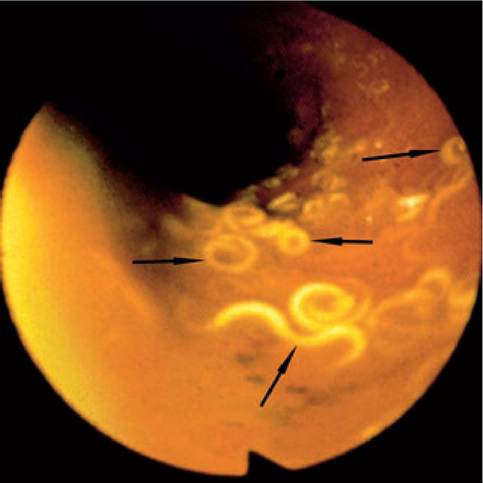
Figure 6.4:
Whipworms. Endoscopic appearance of adult whipworms (arrows) in the ascending colon of a dog.
hatch in the small intestine and burrow into the mucosa for 2-10 days, emerge again, and attach to the mucosa in the cecum and ascending colon, where they complete their maturation.14 Female worms begin producing eggs 70-107 days after the infection has been acquired. Estimates of daily egg production range from 1,000-4,000. Adult worms may live up to 18 months.
Pathogenicity is related to the tunneling of the thin anterior portion of the adult worm into the epithelium of the cecum or ascending colon, producing localized inflammation, mucosal hyperplasia, and in some cases focal granulomatous reac- tions.14,15 Adult worms measure 45-75 mm in length (Figure 6.4).
The worms feed on tissue fluid, blood, and cellular debris. The parasites may be found throughout the large intestine in dogs harboring large numbers of worms.Many infected dogs will not show any clinical signs. The factors contributing to the development of clinical signs include the number of worms present, the location of worms, degree of inflammation produced, level of anemia or hypoproteinemia, nutritional status of the host, and the presence of other GI parasites.14
Although infrequent, infections of human beings with Tri- churis vulpis may occur.14,15 Clients should be warned of the possible public health significance and appropriate sanitary measures should be taken when disposing of fecal material.
Diagnosis
Whipworm eggs can be identified using routine fecal flotation procedures. Zinc sulfate flotation (with centrifugation) has been demonstrated to be more sensitive than other flotation techniques for identifying whipworm eggs.16 However, if multiple fecal examinations fail to identify eggs, treatment for whipworms should be instituted prior to performing additional diagnostic tests. A presumptive diagnosis of whipworm infection can be made if clinical signs improve within 2-3 days of appropriate anthelminthic therapy. Adult worms may be seen in the cecum and ascending colon during colonoscopy if a dog with an occult infection has not been treated prior to performing colonoscopy (Figure 6.4).17 Eosinophilia may be present. Anemia and hypoproteinemia may develop in cases with severe infestation.
Treatment
There are numerous therapeutic agents that are effective against whipworms in dogs.15 Commonly used treatments include fenbendazole (Panacur® at 50 mg/kg PO q 24 h for three days) and a combination of febantel, pyrantel pamoate, and praziquantel (Drontal® Plus at 25 mg/kg febantel PO once).18
Fenbendazole is a safe and efficacious drug with broad-spectrum activity against common GI nematodes, Giardia, and some tapeworms.
Febantel is converted to fenbendazole in the liver. The combination of febantel and pyrantel is synergistic and allows treatment with a single dose. When both are combined with praziquantel, they offer broad-spectrum activity against common GI nematodes and tapeworms.Treatment should be repeated after three weeks and again after three months. The effects of most anthelminthics on the larval stages of whipworms remain unknown.14 After anthelminthic administration has removed the adult worms, larvae still develop into adult parasites and may reestablish infestation. Frequent disposal of feces will help reduce the risk of reinfection. In severe, recurrent cases, heartworm prophylaxis with milbe- mycin oxime (Interceptor® at 0.5 mg/kg PO q 1 month) will help control the whipworm infection.19
Prognosis
Clinical signs rapidly resolve following appropriate therapy. Reinfestation is common in dogs that live in contaminated environments.
6.4.2
More on the topic Whipworms:
- Whipworms
- DISEASES OF THE COLON WITH DIARRHEA AS THE PRINCIPAL SIGN
- Irritable bowel syndrome
- Colitis
- CHRONIC GIARDIASIS
- Appearance of the upper gastrointestinal tract
- History of specific gastrointestinal signs
- DIARRHEA
- Steiner J.M. (ed.). Small Animal Gastroenterology. Schluetersche,2008. — 387 p., 2008
- Index